
“Can You Buy This Painting?” Billionaire Mafia froze because He Thought the Woman in the Painting Was Dead

Dante did not sleep that night.
The city lights shimmered across the Charles River like broken glass, trembling against the dark windows while untouched whiskey sat beside Elena’s painting for hours.
Every few minutes, he looked back at her face again, searching for something he had missed seven years earlier, some warning hidden beneath the paint.
But the woman in the portrait still looked warm, alive, painfully ordinary.
Not like a ghost.
Not like someone who had abandoned him willingly.
Near three in the morning, Dante loosened his tie and finally noticed something strange beneath the painted window frame Elena had created years earlier.
A tiny shape.
Almost invisible.
He stepped closer.
Three small fingerprints pressed faintly into the corner of the dried paint, uneven and imperfect, as though children had touched the canvas while it remained unfinished.
His chest tightened slowly.
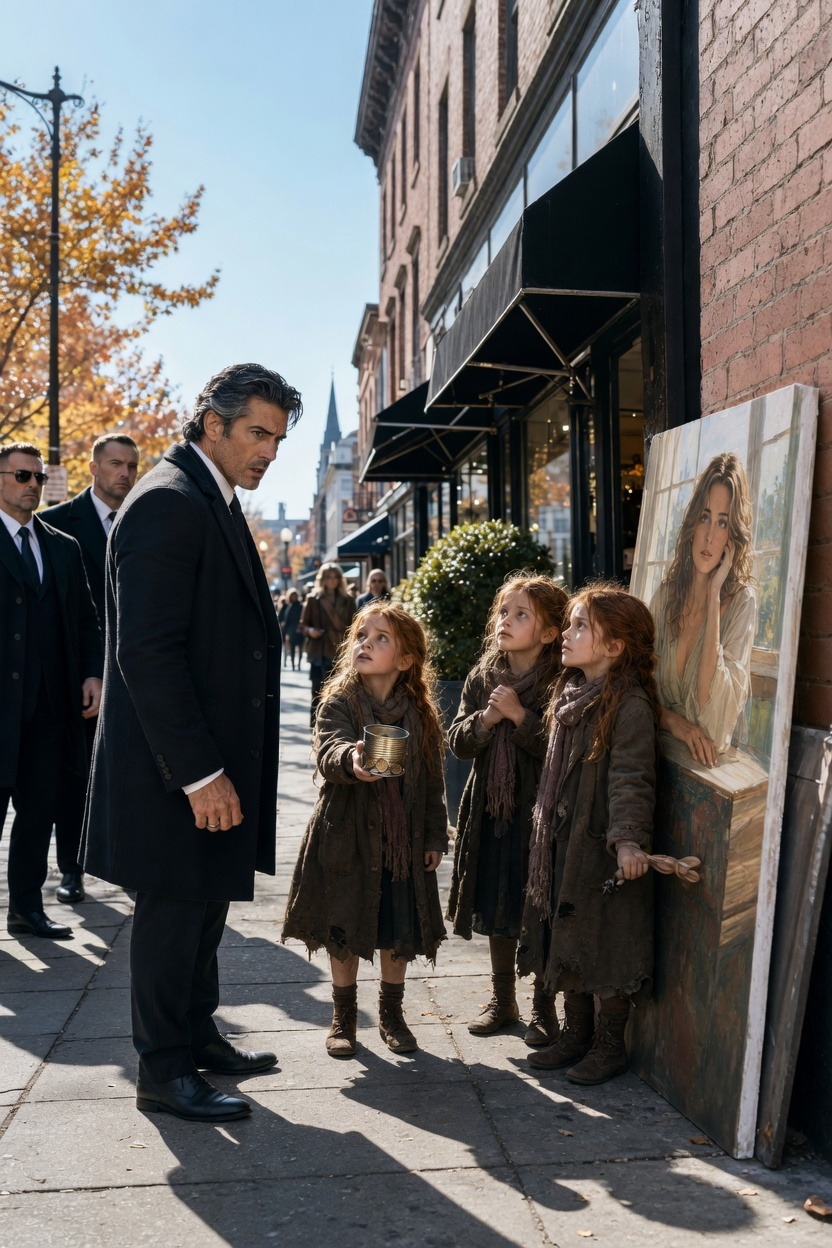
The painting was recent.
Not seven years old.
Someone had been living quietly long after the funeral ended.
Someone had watched him mourn from somewhere close enough to disappear again whenever necessary.
Behind him, Nico entered carefully without knocking, carrying a folder thick with papers and surveillance photographs from across the city.
“We found something,” Nico said quietly.
Dante turned too quickly. “Where?”
“A pharmacy in Dorchester. Cash payments. Same woman twice during the last four months. Security footage is blurry, but the clerk remembered triplets.”
Dante grabbed the photograph immediately.
The image showed a woman in a gray coat standing sideways near a counter beneath fluorescent lighting too harsh for hiding anything completely.
The picture quality was terrible.
But he knew her anyway.
Because of the way she stood.
Elena always leaned slightly onto her right leg whenever exhausted, a habit she hated because she believed it looked awkward and ungraceful.
Dante remembered teasing her about it once inside her gallery while rain hammered softly against the windows behind them.
“You look like somebody waiting for bad news,” he had told her.
She laughed then.
Now the memory felt sharp enough to cut open his ribs.
“When was this taken?” Dante asked.
“Three weeks ago.”
Three weeks.
While he attended meetings, signed contracts, threatened rivals, and stood beside politicians pretending respectability, Elena had apparently been alive only miles away.
Raising three children alone.
Sick enough for medicine money.
Dante closed his eyes briefly.
A dangerous silence settled inside the room.
Nico hesitated before speaking again. “There’s more.”
Dante opened his eyes.
“The pharmacy clerk remembered the oldest girl arguing with her mother.”
“About what?”
“She wanted to ask you for help.”
Dante’s jaw tightened.
“But Elena refused,” Nico continued carefully. “The clerk said she became frightened after hearing your name mentioned on television.”
That hurt more than Dante expected.
Not anger.
Fear.
Elena had feared him enough to hide for years rather than let him near their daughters.
Outside, distant sirens drifted across the sleeping city while Dante stared again at the photograph trembling slightly between his fingers.
“What else?” he asked.
Nico lowered his voice. “Frank Keller called while you were upstairs. He checked the original Interstate Ninety-Three fire report from seven years ago.”
Dante looked up slowly.
“There were inconsistencies.”
The room suddenly felt colder.
“The coroner never confirmed identity through dental records because the body was too badly burned. Identification relied entirely on personal belongings found inside the vehicle.”
Dante remembered the silver bracelet.
The ring.
Elena’s purse.
Her scarf.
Everything had looked convincing enough during grief and rain and smoke and shock.
“Someone wanted you to believe she was d3ad,” Nico said.
Dante said nothing for several seconds.
Then quietly asked, “Who signed the report?”
Nico slid another paper across the table.
Dante stared at the signature.
His pulse slowed dangerously.
Victor Moretti.
A judge-connected fixer working for the Russo organization years earlier before mysteriously retiring overseas with millions nobody questioned too loudly.
Dante remembered Elena meeting Victor once during a charity dinner.
She disliked him instantly.
Afterward she whispered, “That man smiles like he already knows where everyone is buried.”
At the time, Dante laughed.
Now he felt sick.
Because Victor Moretti had vanished only weeks after Elena’s supposed d!3ath.
Nico studied him carefully. “You think Moretti helped her disappear?”
Dante shook his head slowly.
“No.”
His voice became rougher.
“I think Elena was running from something.”
Morning arrived gray and wet over Boston.
Dante spent hours inside his office pretending to review financial reports while Elena’s photograph remained hidden beneath paperwork nobody else was allowed touching.
Every ordinary sound began irritating him.
The ticking clock.
Phone vibrations.
The elevator opening outside.
At noon, his younger brother Luca entered without warning, carrying espresso and suspicion in equal measure.
“You canceled the Caruso negotiation over a painting?” Luca asked.
Dante stayed silent.
“That rumor reached Brooklyn already.”
“I don’t care.”
“That’s exactly the problem.”
Luca sat opposite him slowly, studying Dante with the caution people used around wounded animals capable of sudden violence.
“You look terrible,” Luca admitted.
Dante almost laughed.
Terrible felt insufficient.
For seven years he believed grief had hardened into acceptance.
Now everything inside him had reopened at once.
Luca finally noticed the photograph beneath Dante’s hand.
His expression changed immediately.
“No,” he whispered.
Dante slid the picture across the desk.
Luca stared for a long time before leaning back heavily into his chair.
“That’s impossible.”
“I know.”
Silence stretched between them.
Then Luca spoke more carefully.
“If Elena stayed hidden intentionally, maybe she had reasons you never understood.”
Dante’s throat tightened.
Because he already knew that possibility existed.
Back then, Elena hated violence even in conversation. Whenever Dante received late-night calls and disappeared suddenly, she watched him afterward with worried eyes she tried hiding poorly.
Once she asked directly, “What happens during those meetings?”
Dante lied.
She knew he lied.
Still, she stayed.
Until she vanished.
“What if she saw something?” Luca asked quietly.
The thought had already entered Dante’s mind hours earlier and refused leaving.
He remembered one specific night six months before Elena supposedly d!3d.
She had arrived unexpectedly at one of his restaurants downtown while he met privately with men connected to a dockyard extortion case.
Raised voices.
Threats.
Blood on someone’s mouth afterward.
Elena saw enough to understand pieces she was never meant seeing.
They fought terribly that night.
“You told me you were different from them,” she shouted while packing a bag with shaking hands.
“I am different.”
“You scare people, Dante.”
“They deserve it.”
“And what happens when somebody decides your family deserves it too?”
He remembered the silence after that sentence more clearly than the shouting itself.
Because Elena looked frightened.
Not angry.
Frightened.
Dante suddenly realized something horrifying.
Maybe she never ran from him.
Maybe she ran because of him.
Late afternoon rain covered the city when Frank Keller finally called again.
“We found the girls,” he said immediately.
Dante stood so quickly his chair nearly fell backward.
“Where?”
“A church shelter in Roxbury. They come twice weekly for food donations, but listen carefully before you move.”
Dante already grabbed his coat.
“Frank.”
Something in the older investigator’s voice forced him still.
“There’s a medical file connected to Elena under another surname.”
Dante’s heartbeat slowed.
“What kind of file?”
A pause.
Then quietly:
“Cancer treatment.”
The room seemed to tilt sideways.
For several seconds, Dante heard nothing except air moving somewhere far away through hidden vents inside the building.
“No,” he said finally.
“She stopped treatment months ago because she couldn’t afford continuing.”
Dante pressed one hand against the desk.
Not from weakness.
From sudden unbearable rage.
At himself.
At the years wasted.
At every moment Elena struggled alone while he lived inside penthouses and private clubs surrounded by security and money and power useless against lost time.
“Dante,” Frank continued gently, “there’s something else you need understanding before seeing her.”
But Dante already ended the call.
Rain hammered against the windshield during the drive across Roxbury while traffic lights blurred red and gold through water streaming down glass.
Nico drove.
Neither man spoke.
Dante kept staring at Elena’s painting resting beside him in the backseat like evidence from another life.
He remembered her painting barefoot inside the gallery after closing hours, humming softly whenever concentrating.
He remembered buying groceries together once because Elena insisted wealthy men should learn normal things occasionally.
He remembered touching her stomach absentmindedly one morning before work, both of them still half asleep beneath tangled sheets.
Seven years.
Three daughters.
Cancer.
Fear.
Lies.
Every memory now carried different weight.
By the time they reached the church shelter, evening darkness had settled completely across the neighborhood.
Warm yellow light glowed behind stained-glass windows while volunteers carried cardboard boxes through the rain outside.
Dante remained motionless before exiting the car.
For the first time in years, fear crawled slowly beneath his ribs.
Not fear of enemies.
Not fear of betrayal.
Fear that Elena might look at him and regret being found.
Nico opened the umbrella silently.
“You ready?”
Dante almost answered yes.
But the word refused coming out.
Because suddenly he understood the terrible choice waiting inside that building.
He could drag the truth into daylight.
Demand explanations.
Demand why Elena hid his daughters and let him mourn beside an empty grave.
Or he could accept that whatever happened seven years earlier had probably begun with love twisted into fear.
If he forced everything open now, maybe he would finally get answers.
But he might also lose her again immediately.
This time for real.
Dante stepped from the car slowly.
Rain soaked the edges of his coat while distant church bells echoed softly somewhere above the street.
Near the shelter entrance, three tiny figures appeared beneath the yellow light.
The triplets.
The bold one saw him first.
Her face went pale instantly.
She grabbed her sisters’ hands protectively.
Dante stopped several feet away.
No guards.
No threats.
Only silence and rain between them.
Then the smallest girl whispered something that made the others freeze.
Dante could not hear the words.
But he saw all three children turn slowly toward the shelter doorway behind them.
And there, beneath the warm light spilling into the rain, stood Elena.
Thinner.
Paler.
One hand pressed weakly against the doorframe.
But alive.
Completely alive.
Her eyes met Dante’s across the distance.
Time seemed to stretch painfully thin around them.
The rain softened.
The street sounds disappeared.
Even breathing became difficult.
Elena stared at him exactly the way someone looks at a memory returning years too late.
Then Dante noticed the terror slowly entering her face.
Not terror for herself.
For the children standing between them.
Elena’s hand tightened against the doorframe as though the building itself was the only thing keeping her standing upright through the cold October rain.
The triplets stayed frozen between them, small shoulders tense beneath oversized jackets dampened dark by the weather and the long walk from the shelter entrance.
Dante wanted to move closer.
Instead, he stayed exactly where he was.
Because he finally understood something important.
Every step he took now would feel dangerous to her.
One wrong word could destroy whatever fragile moment still existed between them after seven years of silence, fear, and unfinished grief.
The boldest daughter looked up at Elena carefully.
“Mom?” she whispered.
Elena swallowed before speaking.
“Girls, go inside for a minute.”
None of them moved immediately.
The smallest one glanced nervously between Dante and her mother, as if afraid one of them might disappear while she looked away briefly.
“It’s okay,” Elena said softly.
The girls obeyed slowly.
As they passed him, Dante noticed how thin they were beneath their winter clothes, how carefully they avoided puddles inside worn-out shoes already splitting near the soles.
Guilt settled heavily inside his chest.
When the shelter door closed behind them, silence returned between Dante and Elena except for rain tapping softly against nearby parked cars.
Up close, she looked exhausted.
Not dramatically sick.
Just worn down quietly by years carrying too much alone.
There were faint shadows beneath her eyes now, and her hair seemed shorter than he remembered, tucked carelessly behind one ear against the wind.
But she was still Elena.
Still the woman who once laughed while spilling paint across her own kitchen floor because she danced barefoot during late-night jazz records.
“You found us,” she said finally.
Dante nodded once.
“You painted yourself.”
A weak smile touched her mouth briefly.
“One of the girls needed canvases for school. I reused old supplies.”
Her voice sounded calm, but Dante noticed her fingers trembling slightly beside the doorway.
Not fear alone.
Pain.
The realization made him speak more gently.
“You stopped treatment.”
Elena looked away toward the wet street.
“I ran out of money.”
Dante closed his eyes for one second.
Seven years ago, he could buy entire buildings without checking balances.
Meanwhile Elena counted medicine costs while raising three daughters secretly across the same city.
“You should’ve told me,” he said quietly.
Elena laughed once.
Small.
Tired.
“And said what exactly?”
“That you were alive.”
Rainwater slid slowly down the shelter windows beside them while distant traffic hummed somewhere beyond the narrow street.
Finally Elena looked at him again.
“I saw what your life became after I left.”
Dante said nothing.
Because denying it would insult both of them.
“You were already dangerous before,” she continued softly. “But after the funeral… something changed.”
Dante remembered those years clearly now.
How grief hardened into violence.
How easier it became hurting people after believing the only clean thing in his life was buried underground.
“I thought staying away protected them,” Elena whispered.
“The girls?”
“And you.”
That hurt differently.
Not accusation.
Not anger.
Just sadness stretched across too many unfinished years.
Dante stepped closer carefully, rain soaking his shoulders completely now.
“What happened seven years ago?”
Elena’s breathing slowed.
For several seconds she watched droplets sliding from the church roof while children’s faint laughter echoed somewhere deeper inside the shelter building.
Then she answered.
“That night at your restaurant… after I saw those men beaten downstairs… I wanted to leave Boston.”
Dante remembered.
The fight.
The fear in her face afterward.
“I was pregnant already,” Elena continued. “I hadn’t told you yet.”
Dante’s chest tightened painfully.
“I thought if people discovered you had children, eventually somebody would use them against you.”
He knew she was right.
That was the worst part.
In his world, family became weakness immediately.
Leverage.
Threat.
Target.
“I went to Victor Moretti for help because he handled legal documents quietly for your organization,” Elena said. “I thought he could arrange fake identities and help us disappear safely.”
Dante felt cold despite the rain.
“But Victor wanted money,” she continued. “A lot of it. When I refused, he threatened telling your enemies about the pregnancy.”
Dante’s jaw tightened slowly.
“So you staged the fire.”
Elena nodded weakly.
“Victor arranged everything. Another body from the morgue. My belongings inside the car. He said disappearing completely was the only way protecting the girls permanently.”
“And you never contacted me once?”
Her eyes filled immediately then.
“I almost did.”
The answer came out broken.
“Hundreds of times.”
Dante looked away briefly because hearing that hurt more than anger would have.
“I watched interviews after your father d!3d,” Elena whispered. “You looked empty, Dante. Like grief hollowed everything good out of you.”
Maybe it had.
“I kept thinking once the girls were older, once things became safer, maybe I could explain.”
She coughed suddenly into her sleeve, body folding slightly from the force of it.
Dante moved instinctively toward her.
Elena stiffened immediately.
Not rejection.
Habit.
Years surviving alone had taught her not expecting help quickly.
That realization nearly broke something inside him.
“You need a hospital,” he said quietly.
She shook her head.
“No more hospitals.”
“Elena—”
“I’m tired.”
Those words frightened him more than anything else spoken that night.
Not because they sounded dramatic.
Because they sounded honest.
The shelter door opened suddenly behind them as one of the triplets peeked outside anxiously, auburn hair glowing beneath warm hallway light.
“Mom?”
Elena smiled immediately despite exhaustion.
“I’m okay, sweetheart.”
The child looked uncertain before disappearing inside again.
Dante watched the doorway close softly.
“They trust you,” he murmured.
“They only had me.”
That sentence carried no blame.
Which somehow made it worse.
Weeks passed slowly after that night.
Elena finally agreed to treatment again only after Dante promised the girls would remain with her, no lawyers, no custody threats, no sudden control over lives he barely understood yet.
So Dante learned patience instead.
A difficult lesson for men used to solving problems through force and money.
Sometimes the triplets visited his penthouse reluctantly after school, sitting stiffly on expensive furniture while staring suspiciously at city views through giant windows.
Gradually, small things changed.
One daughter started leaving crayons beside his untouched paperwork.
Another asked shy questions about boats crossing the Charles River.
The quietest girl fell asleep accidentally against his shoulder one evening during a movie she pretended not liking.
Dante sat motionless for nearly an hour afterward.
Afraid moving would wake her.
Afraid the moment might disappear somehow.
But consequences still arrived eventually.
Federal investigations surrounding Victor Moretti reopened old financial records connected to the Russo organization years earlier.
Names surfaced.
Payments.
Violence.
Corruption nobody could bury forever.
For the first time, Dante saw clearly what Elena once feared becoming part of their daughters’ lives.
Late one evening, he stood alone inside Elena’s small apartment kitchen while she prepared soup slowly beside the stove, thinner now after chemotherapy but still stubbornly independent.
“You should leave Boston,” he said quietly.
Elena looked up immediately.
“And you?”
Dante watched steam rise from untouched bowls across the counter.
“I can’t undo what I built.”
Silence filled the room.
The girls laughed faintly from another room while cartoons flickered somewhere beyond the hallway.
Elena studied him carefully.
“For years I blamed you for becoming someone frightening,” she admitted softly. “But I think grief helped build that version too.”