Minutes before signing the marriage certificate, a woman on the street grabbed her hand and whispered, “If you get married, you’ll die”; hours later, back in her new home, she saw a message on her husband’s cell phone that left her frozen… Spotlight8

“If you marry that man, you won’t live long.”
That was the first thing I heard on my wedding day, right outside the Civil Registry of Coyoacán, while I was holding my bouquet of white peonies and trying to convince myself that the pit in my stomach was pure nerves.
My name is Sofia, I was thirty-three years old, and according to my family, I was about to take “the plunge” with the perfect man. Rodrigo was successful, self-assured, polite, the kind of guy who knows exactly what to say to make a good impression. He worked in real estate, drove a spotless SUV, and ever since we met at a dinner party with friends, everyone kept telling me the same thing: “Don’t let him go, men like that are hard to find anymore.”
My mom, Marta, cried when I told her we were getting married. My friend Claudia teased me, saying I’d finally stop being “the elegant spinster” of the group. Even my coworker Mariana hugged me at the office like I’d won the lottery. And me… I was smiling. Because I was happy, but not at peace. There was something inside me that just wouldn’t settle, like when a door isn’t properly closed and the wind moves it even though you swear you’ve locked it.
That morning I woke up before dawn, put on a simple ivory dress, and tried to ignore that silly feeling. On the way to the Registry, Rodrigo was unusually quiet. His cell phone rang several times. He glanced at it and put it away without answering.
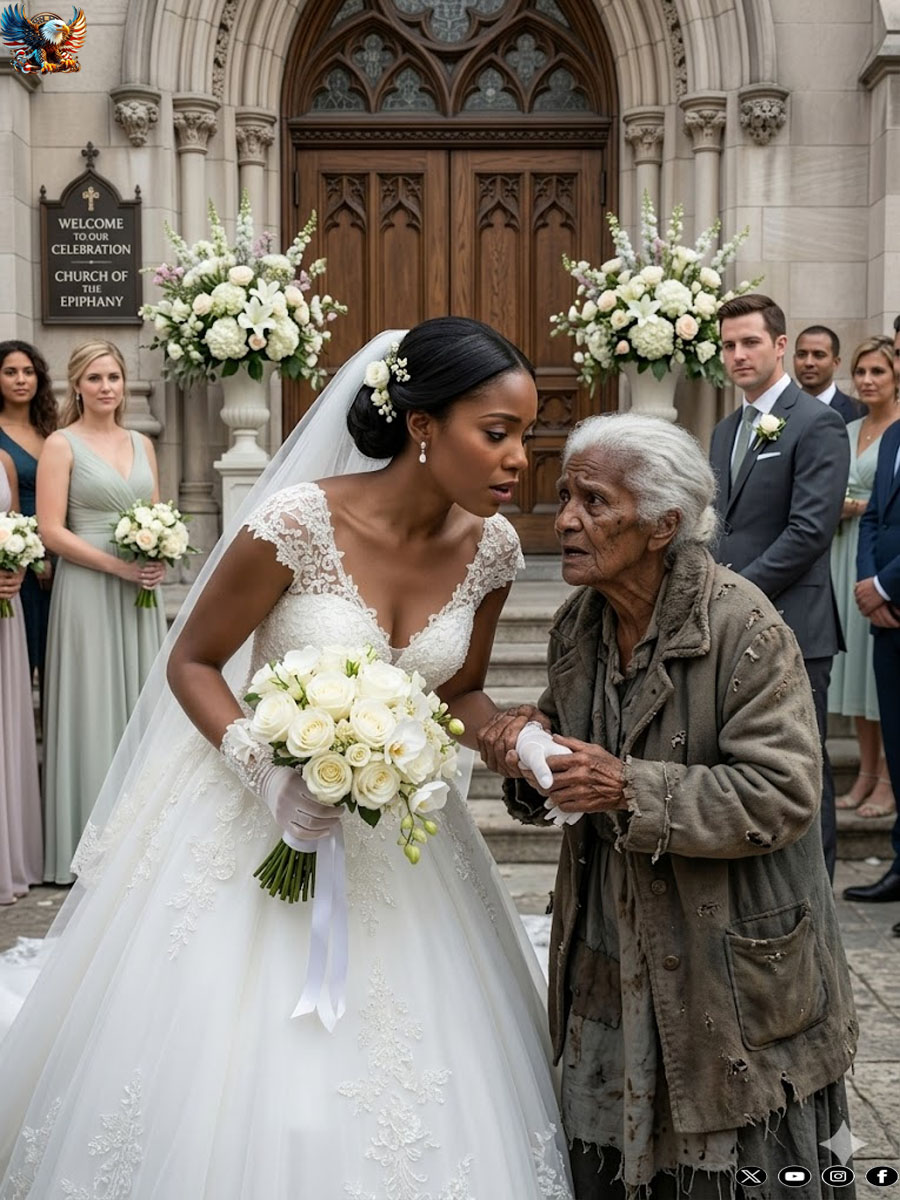
When we arrived, she said she had to take a work call and walked off toward a tree. I stayed in the doorway, straightening my dress, when an older woman, wearing a worn dark coat and with her gray hair pulled back, approached me to ask for water. She looked like she’d slept on the street, but she had the most alert eyes I’ve ever seen.
I gave her a small bottle I had in my bag. She took a couple of sips, grabbed my wrist, and opened my palm as if she were going to read it.
“If you marry that man, your life will be shortened,” she told me in a low voice.
I felt a chill.
-Sorry?
Listen carefully. If he gives you a paper to sign today, don’t sign it. Tell him to do it later. Even if he gets angry. Even if he pressures you. Don’t sign it.
I wanted to pull away and tell her she was crazy, but at that moment Rodrigo came back. He didn’t even turn to look at her. He grabbed my elbow harder than necessary and pulled me inside.
We got married.
I signed the papers. I smiled for the photos. I received hugs, toasts, and congratulations. My mother cried. My mother-in-law, Teresa, looked at me with that elegant coldness I never understood. Everything seemed normal… until, already in the car on the way to dinner, Rodrigo took a beige folder out of the glove compartment.
“All we need to do is go to the notary,” he said, as if he were talking about traffic. “It’s a property agreement, just a formality. You sign it today and we can forget about it.”
I felt the woman’s voice echoing in my head.
“I’m not going to sign anything today,” I replied.
Rodrigo didn’t respond immediately. He just gripped the steering wheel. His jaw tightened, hard, ugly, unfamiliar.
That night, back at the apartment, while he was taking a bath, his cell phone lit up on the kitchen table.
The message read: “So he did sign?”
And at that moment I understood that something much worse was hidden behind my wedding.
I couldn’t believe what was about to happen…
PART 2
I stared at the screen as if it was going to turn off by itself and erase what I had just read.
He didn’t.
The contact’s name was Marcos. Rodrigo never put a password on his phone; he always said that honest people don’t need to hide anything. I opened it with freezing hands and went into the chat.
The first thing I saw was a message from two weeks earlier:
Marcos: “Did the lawyer finalize the clause?”
Rodrigo: “Yes. The important thing is that the apartment and land deal is tied up.”
Marcos: “And does she understand what she’s going to sign?”
Rodrigo: “No. She trusts me.”
I kept going down.
My apartment in the Narvarte neighborhood, the one my father put in my name years ago. A small plot of land in Cuernavaca that I had inherited from my aunt. A savings account. Everything was mentioned with a coldness that made my stomach churn. They weren’t talking about me as a wife. They were talking about me as a file.
Then the real blow came.
Marcos: “Without the signature, if something happens, it’ll be difficult to collect the insurance.”
Rodrigo: “That’s why I wanted to finalize it today. It was almost done.”
Marcos: “And what if things get tough?”
Rodrigo: “People will trust you. They always trust you.”
I had to sit down. The kettle was already boiling behind me, but I couldn’t move. I felt my heart in my throat.
Keep reading.
They had talked for weeks. About the lawyer. About the agreement. About timing. About not raising suspicion. About waiting a while after the wedding so everything would seem normal. About how convenient it was that I had already moved into his apartment.
And then I got to the messages from three days before we got married.
Marcos: “Now that everything’s signed, we just have to wait.”
Rodrigo: “Two months, tops. If it’s sooner, it’ll be too obvious.”
Marcos: “What will it look like? A robbery? An accident?”
Rodrigo: “It’s cleaner at home. Fewer cameras. Fewer witnesses.”
I felt like I couldn’t breathe.
I didn’t cry. I didn’t scream. I did the only thing I could do: I took out my phone and took pictures of the entire conversation. One by one. My hands were shaking so much that I had to redo several. I uploaded them to the cloud, transferred them to a USB drive, and left Rodrigo’s phone exactly where it was.
When he came out of the bathroom, he kissed my head as if nothing had happened.
“Aren’t you going to sleep?” he asked me.
“Right now,” I told him, and I don’t know how I managed to make my voice sound normal.
That morning I packed a small suitcase with my documents, cards, deeds, and some clothes. The next morning I told her I was going to see my mom because she wasn’t feeling well. She didn’t even get up to say goodbye.
I didn’t go to my mom’s house.
I went with Fernanda, a lawyer friend from university, and she got me an appointment that same day with attorney Salgado, an older, reserved, and brilliant criminal lawyer who didn’t waste a single minute comforting me. He looked at the photos and told me:
—You’re not going back to him. You’re not signing anything. And from here we’re going straight to the Public Prosecutor’s Office.
That was the moment I understood that I wasn’t running away from a failed marriage.
I was running away from the man who had planned to make me a widow of myself.
And the worst part was that we still had to face it all seriously.
If she wanted to get out of that story alive, the hardest part was just about to begin.
PART 3
I filed the complaint that same day.
Attorney Salgado insisted on taking the case to a central prosecutor’s office, not the local ministry, because with such evidence, he couldn’t afford for someone to misplace it. I handed over screenshots, dates, names—everything. An expert later confirmed that the messages had indeed come from Rodrigo’s phone and that Marcos existed: his name was Marcos Rivera, he had a record for fraud, and he had been investigated before for shady dealings with insurance policies and properties.
For weeks I lived hidden in my empty apartment in Narvarte. I changed the locks, lowered the blinds, stopped posting anything on social media, and learned to answer Rodrigo’s calls with the coldest voice I could muster.
First he feigned concern.
—Sofi, you’re exaggerating. Come here and we’ll talk.
Then he got angry.
—Don’t make me look bad in front of people.
Then he moved on to blackmail.
—My mom is devastated. Your mom doesn’t understand anything. Are you really going to ruin everything because of paranoia?
That sentence finally opened my eyes: for him, the serious thing wasn’t that I had discovered a plot to kill me. The serious thing was the scandal.
When he was arrested, he was in his office.
Marcos was caught the same day.
I thought I would feel immediate relief, but no. What I felt was exhaustion. A brutal, old exhaustion, as if I had aged suddenly in less than a month.
The trial lasted several months. My mother-in-law attended every hearing. She never spoke to me. She just looked at me as if I were the one responsible for her son ending up in handcuffs. My mother cried more at that trial than at my wedding. My father, who almost never spoke, took my hand as we left a hearing and said something I will never forget:
—Forgive me for teaching you to distrust your intuition and trust appearances more.
Rodrigo received eight years for attempted femicide with premeditation. Marcos got less, because he ended up cooperating. The divorce was finalized quickly after that. When I went to get my things from the apartment where “we were going to start our life together,” I still saw a cheesy magnet on the fridge that he had bought on a trip to Valle de Bravo. It said, “Happiness is you.” I tore it off and threw it in the trash.
But this story did not end with the trial.
A week after the sentencing, I went back to the Civil Registry to look for the woman who had saved me. It took me several days to find her. Her name was Valentina. She slept intermittently under an awning near a pharmacy and survived on what people gave her. When I finally saw her and thanked her, she confessed something that left me speechless:
“I didn’t read your palm, daughter. That was just a pretext to get you to listen to me. What I saw was his face when he was on the phone. I already knew that face. My husband also had one face for the world… and another to destroy me.”
I rented her a room. I helped her get paperwork done, apply for support programs, and start over. And, without realizing it, while I wanted to repay her for saving me, she ended up teaching me something much greater.
That sometimes danger doesn’t come screaming: it comes smiling, perfumed, and with a ring on its hand.
That many women don’t die from “bad luck,” but from trusting the wrong person.
And that sometimes, the only person who dares to tell you the truth… is precisely the one everyone else prefers to ignore.
Since then, every time a woman tells me, “Maybe I’m exaggerating,” I give her the same answer:
Don’t ignore that feeling that’s squeezing your chest. Sometimes intuition doesn’t warn you too late. It warns you right on time.

Related posts