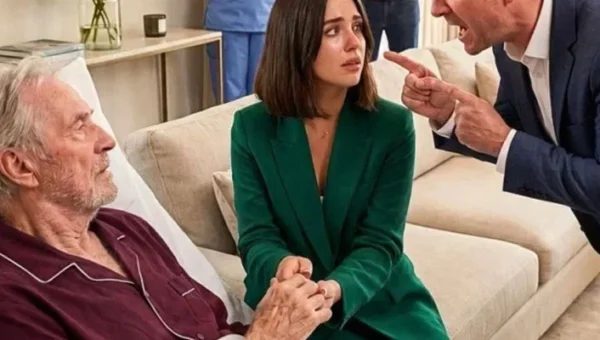
My mother-in-law poured boiling oil on my arms, then forced me to say I was just “clumsy” while cooking. At the hospital, my husband held my hand, weeping to the doctor: “She’s so scatterbrained, she tripped! Please, save her beautiful skin!” He expected pity. Instead, the burn specialist didn’t even look at him. He examined the splash pattern on my skin with a terrifyingly calm face. He stood up, blocked the door, and told the nurse: “The trajectory of these burns is downward and intentional. This wasn’t a trip; it was an attack. Lock the wing. Call the police.”

- 1. The Gilded Cage of the Montgomery Estate
- 2. The Boiling Lesson
- 3. The Forensic Truth
- 4. The Breaking of the Silent Vow
- 5. Scars of Resilience
- 6. The Unbroken Life
1. The Gilded Cage of the Montgomery Estate
The chronicle of my own survival began in a room designed to make me feel entirely insignificant.
Before I became a Montgomery, I was an editor at a boutique publishing house in Manhattan. I spent my days surrounded by the smell of ink and old paper, dissecting narratives and helping voices find their strength. But the moment I married into the Montgomery family, my own voice was systematically redacted. I traded my manuscripts for the suffocating role of the “perfect wife,” a prop in a dynasty that measured worth by optics and obedience.
The dining room of the Montgomery estate in upstate New York was a cold expanse of polished mahogany, shadowed by heavy velvet drapes and an oppressive silence. It smelled of rare beef and old money. I sat at the ridiculously long table, my spine rigid, carefully placing my crystal water goblet onto a silver coaster.
A sharp, audible sigh cut through the quiet.
Clara, my mother-in-law, sat at the head of the table. She was a woman of terrifying elegance, her silver hair perfectly coiffed, her silk blouse pristine. She ruled the family with a velvet glove wrapped around a steel fist.
“Ten degrees to the left, Ava,” Clara said, her voice a sharp, slicing blade that barely disturbed the air. “Your mother clearly didn’t teach you that precision is the hallmark of a lady. That glass is practically falling off the edge.”
It was perfectly centered, but reality in this house was whatever Clara dictated.
I looked across the table at Mason, hoping for a sliver of a reprieve. My husband was a highly successful corporate defense attorney, a man who charmed juries and dazzled the press with his philanthropic smiles. But in this room, he was simply his mother’s accomplice. He was busy slicing his steak with clinical, detached focus.
“Listen to Mother, Ava,” he said smoothly, not even bothering to lift his gaze from his plate. “She’s only trying to polish you into something worthy of our name. You’ve been terribly scatterbrained lately.”
The gaslighting was a daily, suffocating fog. They were building a narrative of my incompetence, brick by brick.
Clara stood up and walked slowly toward my chair. I stiffened instinctively. As she leaned over to “correct” my posture, her manicured fingers clamped down hard on my bare shoulder. Her fingernails dug deep into my skin, leaving sharp, crescent moons of white pressure that radiated a dull ache down my collarbone.
“We have to fix your clumsiness before the charity gala next week,” Clara whispered directly into my ear. There was a cold, reptilian glint in her eyes that promised a lesson much harsher than mere words. “I will not have a clumsy, ungrateful girl ruining this family’s reputation.”
The heavy grandfather clock in the hallway chimed eight times, sounding like a death knell. I stared down at my plate, my throat tight with unshed tears, trapped in a psychological web so fine I couldn’t even prove it existed to the outside world.
When the plates were finally cleared, Clara wiped her mouth with a linen napkin. She didn’t look at me as she delivered her final command of the evening. “Come into the kitchen, Ava. It’s time you learned how to prepare my signature herb-infused oil. Perhaps a little heat will sharpen your dull mind.”
Mason stood up, smoothing his tailored suit jacket. He didn’t offer a reassuring touch. He didn’t ask if I was okay. He simply turned his back, walked into his mahogany-paneled study, and pulled the heavy doors shut. The loud, definitive click of the lock echoing in the hallway was the sound of my only supposed protector sealing me in with the wolf.
2. The Boiling Lesson
The kitchen was a sprawling, industrial-grade chef’s paradise, all gleaming stainless steel and stark white marble. It felt less like a place of nourishment and more like an operating theater.
Clara stood by the massive gas range. A heavy-bottomed cast-iron pot sat on the largest burner, the pale yellow oil inside shivering and smoking, radiating a wave of intense heat that made the air wobble. I stood a few feet away, my heart hammering against my ribs like a trapped bird.
“Come closer,” Clara commanded, pointing to the spot directly beside the stove. “You can’t learn if you’re cowering in the corner like a stray dog.”
I took a hesitant step forward, the heat pressing against my face. “Clara, it’s smoking. I think it’s too hot—”
“I did not ask for your editorial opinion, Ava,” she snapped. She reached out and grabbed the thick handle of the pot.
What happened next didn’t occur in a blur of motion, but in a terrifying, hyper-focused slow motion. Clara didn’t stumble. She didn’t slip. She looked me dead in the eyes, her expression settling into a mask of terrifying, blank indifference.
With a deliberate, sweeping motion, she tilted the heavy pot.
The scream died in my throat before it could even form. The searing, viscous liquid hit my forearms and splashed across my lower stomach. It wasn’t just heat; it was an absolute, blinding white-out of agony that dissolved my reality. The smell of burning fabric and scorching flesh hit the air instantly.
My knees buckled. I collapsed onto the imported tile, gagging on the pain, my arms convulsing as the oil clung to my skin, continuing to cook me even as I thrashed.
Clara stood towering over me, the empty pot swinging loosely in her hand. “Now,” she hissed, her voice dripping with sadistic satisfaction, “you have something to be truly clumsy about.”
Heavy footsteps pounded down the hallway. Mason burst through the swinging doors. For one fleeting, delusional second, I thought he would save me. I thought the horror of seeing his wife writhing on the floor would snap the spell his mother had over him.
He stopped. He looked at the smoking oil pooled on the floor. He looked at the horrific, blistering red welts bubbling up on my arms. Then, he looked at his mother’s calm, unbothered face.
He didn’t pull his phone out to call 911. He didn’t run to the sink for cold water.
Mason dropped to his knees, grabbed a kitchen towel, and began frantically wiping the excess oil off the pristine marble floor. Only then did he turn to me. He grabbed my burning arms, not with tenderness, but with a brutal, bruising grip on my biceps that pinned me to the floor, forcing me to look at him.
“You tripped, Ava,” Mason said, his voice frantic but entirely devoid of empathy. “You were being scatterbrained, you weren’t paying attention, and you tripped over the rug while carrying the pot. Say it!”
“Mason, please… it burns, God, it burns…” I sobbed, struggling against his grip, the pain making my vision tunnel into darkness.
His fingers dug deeper into the bruises Clara had started at dinner. “Say it, Ava! If you don’t say it, the police will come. They’ll say you’re unstable. They’ll lock you in a ward. Say you tripped!”
Through the haze of absolute agony, I felt the suffocating weight of their combined gaze—a twisted, monstrous family unit forged in cruelty and self-preservation. They were going to let me burn right here on the floor if I didn’t comply.
“I… I tripped,” I managed to choke out, the words tasting like ash in my mouth.
Mason immediately loosened his grip. The frantic edge vanished from his face, replaced by his smooth courtroom persona. He nodded, reaching out to wipe a stray tear from my cheek with a terrifying parody of affection. “Good girl. Let’s go to the hospital. We’ll tell them how adventurous you were trying to cook for my mother.”
By the time the wailing ambulance arrived at the front gates, my arms were wrapped in wet towels. As the paramedics loaded me onto the stretcher, Mason leaned over, his face inches from mine. He grabbed my hand, his thumbnail pressing sharply into a raw, unbandaged blister near my wrist.
“One wrong word to the doctors,” he whispered, a smile plastered on his face for the paramedics, “and you will disappear, Ava. You will simply cease to exist.”
3. The Forensic Truth
The emergency wing of the hospital was a chaotic symphony of glaring fluorescent lights, the smell of sterile iodine, and the frantic beeping of monitors. It was a world built on trauma, but it was also a world built on evidence.
They rushed me into a trauma bay, cutting away the ruined silk of my blouse. The pain had transcended physical sensation; it was a loud, roaring static in my head.
Mason was performing the role of a lifetime. He was a portrait of the distraught, wealthy husband. He hovered near the head of my bed, his designer tie askew, his voice cracking with perfectly modulated panic as he spoke to the attending staff.
“She’s so scatterbrained, Doctor, she’s always rushing around,” Mason pleaded, wiping fake tears from his eyes as a tall man in a white coat entered the room. “She tripped over the kitchen rug while trying to move the hot oil. Please, do whatever it takes! Save her beautiful skin! She’s my whole world.”
Dr. Silas Harrison was a man who seemed carved from granite. He was the head of the burn unit, a specialist with deep, observant eyes and an aura of absolute, unshakeable calm. He had spent decades reading human tissue like a grim, forensic text.
Dr. Harrison didn’t look at Mason. He didn’t offer a comforting nod. He didn’t even acknowledge the man’s sobbing performance.
He moved silently to the side of my bed, adjusting the intense, halogen examination light. His face was a terrifyingly calm mask as he gloved his hands.
“Hello, Ava. I’m going to look at your arms now,” he murmured, his voice a low, steady rumble that commanded the room.
I kept my eyes squeezed shut, trembling violently, Mason’s threat echoing in the dark corners of my mind.
Dr. Harrison gently lifted my right arm. He didn’t just see the blistering ruin of my skin; he read the story it told. He traced the outer edges of the severe second and third-degree burns. He noted how the oil had splashed in a highly concentrated, thick, downward stream, pooling heavily on the tops of my forearms and the front of my thighs.
He narrowed his eyes. He looked for the splash patterns that always accompanied a fall—the lateral spray across the cabinets, the chaotic dispersion of liquid when a body hits the floor holding a container. There were none on my clothes.
Then, he pushed my hospital gown slightly off my shoulders to examine the upper limits of the burn.
He paused.
There, stark against my pale, unburned skin, were dark, deep bruises. Fingerprints. Three on the front of the bicep, a thumb pressing into the back. They were fresh, layered perfectly over the older, crescent-moon indentations Clara had made hours earlier. They were the undeniable, biomechanical markers of someone being forcefully held down from above.
Dr. Harrison slowly lowered my arm. He took off his gloves, dropping them into the biohazard bin with a soft snap. He stood up to his full height, turning his broad shoulders to completely block the only exit from the trauma bay.
He didn’t speak to Mason. He turned to the head triage nurse standing by the monitors.
“The trajectory of these burns is entirely downward and intentional. The fluid dynamics do not match the provided narrative,” Dr. Harrison stated, his voice ringing out with chilling authority. “This wasn’t a trip. It was an attack. Lock down the wing immediately. Call the police.”
Mason’s performance shattered instantly. The fake tears evaporated, and his face contorted into a mask of cold, vicious arrogance. He took a threatening step toward the doctor.
“Listen to me, you arrogant hack,” Mason snarled, jabbing a finger at Dr. Harrison’s chest. “Do you have any idea who you are making accusations against? My family owns half the board of this hospital. You’ll be fired and blacklisted before my wife is even bandaged!”
4. The Breaking of the Silent Vow
The atmosphere in the trauma bay shifted from frantic medical urgency to the terrifying stillness of a hostage situation. Mason stood with his chest puffed out, radiating the toxic entitlement of a man who had never been told “no” in his entire life.
Dr. Harrison didn’t back down an inch. He was immovable. “I am the one making the medical record, Mr. Montgomery,” the doctor said, his voice like cold iron striking an anvil. “And the forensic record clearly states this was a violent struggle. Your board seats mean nothing in my trauma bay.”
The heavy automatic doors hissed open. Two uniformed police officers, responding to the Code Gray, strode into the room, hands resting cautiously near their utility belts.
For the first time in three years, I felt the physical space between myself and my husband expand. The impenetrable wall of the Montgomery family was suddenly cracking. Dr. Harrison’s clinical, absolute refusal to buy into their gaslighting was a lifeline thrown into my dark, suffocating ocean.
I looked at Mason, his face flushed with rage as an officer asked him to step back. I looked at the doctor, who was watching me with a steady, encouraging gaze. He had read the truth on my skin when I was too terrified to speak it.
I realized then that if I stayed silent now, I would die in that house.
“Ava, tell them,” Mason commanded, a desperate edge bleeding through his anger. “Tell them it was an accident. Tell them about your postpartum instability.”
I didn’t have a child. The lie was so absurd, so calculated to make me look insane, that it finally snapped the invisible tether holding my tongue.
I took a ragged, agonizing breath. My voice was small, raspy from screaming, but it did not tremble.
“He held me,” I whispered.
The room went dead silent.
I raised my uninjured, shaking index finger and pointed directly at Mason. “He held me down on the floor. His mother… Clara… she poured the boiling oil on me because I was ‘clumsy.’ They practiced the story in the kitchen while my skin was melting. He told me he would make me disappear if I told the truth.”
The room exploded into motion.
“She’s delusional! It’s the trauma! She’s having a psychotic break!” Mason roared, lunging forward toward my bed, his hands reaching for me.
He didn’t make it. The two officers caught him mid-air, slamming him hard against the tile wall. The metallic snick-snack of handcuffs ratcheting tight echoed over the hum of the medical equipment.
As they dragged him toward the door, he thrashed wildly. I watched the man I thought I loved, the powerful, untouchable attorney, instantly devolve into a sniveling, desperate coward. His threats and curses echoed down the sterile hallway, growing fainter and fainter until the heavy trauma doors swung shut, sealing him out of my life forever.
An hour later, as a nurse was carefully administering morphine and preparing me for the surgical debridement, one of the arresting officers returned to the room. He took off his hat, looking grim.
“Ma’am,” the officer said gently. “We dispatched a team to the Montgomery estate to arrest your mother-in-law based on your statement.” He paused, looking down at his notebook. “But when they arrived, they couldn’t execute the warrant. The entire east wing of the house, starting in the kitchen, was completely engulfed in flames. It looks like an ‘accidental’ fire.”
5. Scars of Resilience
The skin grafts were a grueling, agonizing process. It was a completely different kind of pain than the boiling oil. The burns were an assault; the grafts were an excavation. It was the deep, itching, pulling ache of reconstruction, of my body forcefully knitting itself back together piece by piece.
I spent nearly three months in the burn unit, and then another four in intense physical and psychological therapy. Dr. Harrison was my surgeon, but he also became a fierce advocate. When I couldn’t hold a pen, he sat by my bed and took notes as I dictated everything I remembered about the financial documents Mason kept hidden in his study. He connected me with specialized legal teams who handled high-net-worth domestic abuse cases.
I sat on a concrete bench in the hospital’s recovery garden on a crisp autumn afternoon, the wind carrying the scent of dying leaves. I rolled up the sleeves of my soft cotton sweater and looked down at my forearms.
They were covered in intricate, shiny, raised patterns of pink and white tissue. Once, I would have looked at them with horror, mourning the “perfect” skin Clara had demanded. Now, I looked at them as a map of the hell I had walked through. They were proof of my endurance.
In the real world, beyond the hospital walls, the Montgomery name had been dragged through the mud and shattered. It had become a national synonym for depravity and privilege gone wrong.
Clara hadn’t died in the fire. The police found her a mile down the road, her silk clothes smelling of gasoline, a packed suitcase in the trunk of her Mercedes. She had tried to burn the kitchen down to destroy the forensic evidence of the attack, completely underestimating the speed at which modern accelerants travel.
She was currently sitting in a state penitentiary, facing ten to fifteen years for aggravated assault, attempted murder, and arson.
Mason’s downfall was even more spectacular. His pristine law license had been permanently stripped away. Facing a mountain of forensic evidence corroborated by Dr. Harrison, and terrified of going to a maximum-security prison, he had turned state’s evidence against his own mother. He was serving a five-year sentence for complicity, obstruction of justice, and witness tampering.
He had tried to write me letters from his cell, pathetic, rambling pages claiming he was “forced” by his mother’s domineering personality, begging for forgiveness. I never opened a single one. I handed them directly to my lawyers. I didn’t need his explanations or his fake remorse. I was too busy learning how to use my hands again—not to serve others, not to chop vegetables perfectly on a marble counter, but to write my own story.
My apartment in the city was small, but it was entirely mine. I was packing up the last of the boxes from a storage unit that held the few belongings I had salvaged from the estate before the fire.
As I emptied a dusty box of old editorial files, a small, black plastic rectangle fell out onto the floor.
I froze. It was a digital voice recorder.
Months before the attack, when the gaslighting had reached a point where I thought I was genuinely losing my mind, I had hidden it under the lip of the kitchen island to record my own conversations, just to prove to myself that I wasn’t crazy. I had completely forgotten about it.
I picked it up with my scarred hands, my heart pounding, and pressed play.
It hadn’t just recorded the day of the attack. It had captured months of audio. And as Clara’s cold, calculating voice filled my quiet living room, detailing not just her hatred for me, but a chilling, methodical plan to drain my personal trust fund into an offshore shell company, I realized the depths of their depravity went far beyond physical violence.
6. The Unbroken Life
Time does not erase trauma, but it shifts the weight of it. It moves from being a boulder crushing your chest to a stone you carry in your pocket—a constant, tactile reminder of what you can survive.
Two years had passed since the night in the kitchen.
I stood behind a podium on the stage of a crowded, brightly lit auditorium at a university in Boston. The room was packed with law students, medical professionals, and social workers. I was no longer an editor hiding behind other people’s words, and I was certainly no longer the silent, trembling wife of a Montgomery.
I was an author, an advocate, and a survivor.
I took a deep breath, the air filling my lungs freely. I deliberately rolled up the sleeves of my tailored blazer, exposing my forearms to the hundreds of eyes in the room. I no longer hid my scars beneath long silk shirts or thick sweaters.
“For a long time, I was told I was clumsy,” I said, my voice projecting clearly and resonantly through the microphone, echoing off the high ceilings. “I was told by the people who were supposed to protect me that I was the source of the chaos in my life. I was conditioned to believe that my pain was an inconvenience to their perfection.”
The audience was dead silent, hanging on every syllable.
“But I learned something in a trauma bay,” I continued, looking out at the sea of faces. “These scars aren’t a record of my failures. They are not a brand of my clumsiness. They are the undeniable evidence of my strength. They are the marks of a woman who refused to be burned into silence.”
After the symposium concluded, I stood in the lobby, signing copies of my book. The line was long, filled with people sharing their own stories of escaping dark places.
A young woman approached the table. She was wearing a heavy cardigan despite the warmth of the room, her eyes wide, darting around nervously, carrying a familiar, hunted look that punched me straight in the heart.
She didn’t hand me a book. She just looked at my arms, then down at her own trembling hands.
I didn’t offer her a platitude. I stood up, walked around the table, and reached out. I gently took her hands in mine. The skin-to-skin contact was firm, warm, and grounding. She flinched slightly, but then relaxed into the grip.
“You don’t have to stay in the fire,” I whispered to her, looking directly into her eyes. “There are people who will see the truth, even when you are too terrified to speak it. You just have to find the door.”
She nodded, a single tear cutting through her makeup, and squeezed my hands back.
I walked out of the auditorium doors and into the brilliant, blinding sunlight of the late afternoon. The air smelled of city pavement and possibility.
My phone buzzed in the pocket of my blazer. It was a text message from the lead prosecutor who had handled Mason’s case.
Ava, the message read. We finished decoding the encrypted files mentioned on that audio recorder you found. It opened up a completely new investigation. We are looking into the mysterious circumstances surrounding your father-in-law’s death ten years ago. Clara wasn’t acting alone.
I stopped on the sidewalk, the crowds of people rushing past me. I read the message twice.
My fight for my own justice had ended, but the war against the Montgomery legacy was apparently just beginning. And this time, they weren’t dealing with a terrified, isolated girl in a locked house. They were dealing with a woman forged in their own fire.
I locked my phone, slipped it back into my pocket, and smiled. I stepped forward into the sunlight, my scars catching the light, no longer afraid of whatever shadows lay ahead.
If you want more stories like this, or if you’d like to share your thoughts about what you would have done in my situation, I’d love to hear from you. Your perspective helps these stories reach more people, so don’t be shy about commenting or sharing.