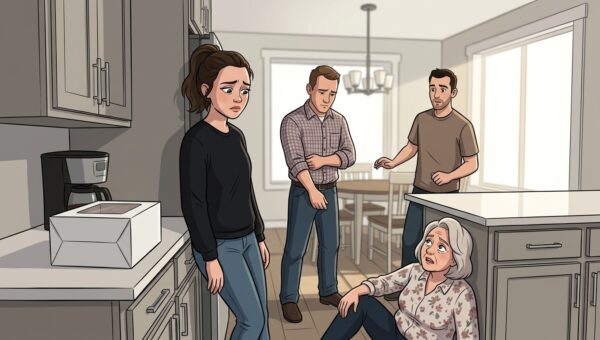
My mother married me off for a million and a half dollars to an old bachelor. I thought my life would turn into a living hell… but I didn’t know that, upon entering the bedroom on our first night, a truth awaited me that would shatter my soul. Spotlight8

but inside them lay a sadness so still that it terrified me more than any scream.
—”I have cancer,” he finally said. “Pancreatic. The doctors aren’t talking about years anymore, Valerie. They’re talking about months.”
The letter slipped from my hands. I didn’t know whether to feel pity, relief, or rage. Perhaps all three at the same time. I had gone up to that room believing a monster was waiting for me behind the door, and instead, I had an old, sick, tired man sitting in front of me, asking for forgiveness with his eyes.
—”And what do I have to do with that?” I asked, unable to stop my voice from sounding harsh. “Why drag me into your death?”
Mr. Sullivan closed his eyes for a moment. —”Because before I die, I need to right a cowardly act I committed many years ago.”
I felt something shift deep in my chest. —”I don’t understand.”
He reached into the pocket of his sweater and pulled out an old photograph, its corners folded. He stood up slowly, walked over to the bed, and placed it on the quilt, without coming any closer. In the photo was a young man in a denim shirt, holding a yellow hard hat under his arm, with a smile I knew better than my own name.
My dad.
I ran out of air. I picked up the photograph with trembling hands. —”Where did you get this?”
Mr. Sullivan swallowed hard. —”Your father worked for me.”
The room started to spin. —”My dad was a construction worker.” —”He was the best foreman I ever had in my company,” he replied. “Honest, punctual, stubborn as a mule, and with hands that could build a straight wall even out of crooked stones. His name was Matthew Harrison. And sixteen years ago, he saved my life.”
The photo blurred in my vision. —”My mom said he died in an accident.” —”Yes,” he whispered. “But it didn’t happen the way they told you.”
I stood up abruptly. —”No.” —”Valerie…” —”Don’t say anything.” —”You have the right to know.” —”No!”
The scream came out so loud it scared me. I covered my mouth, but it was too late. The whole house seemed to stay still, listening.
Mr. Sullivan didn’t move. —”The construction site was in Louisville,” he continued, his voice breaking. “A three-story building. I had gone to inspect it because there were rumors that the site manager was buying cheap materials and pocketing company money. Your dad had already reported him, but no one listened to him. That day, a concrete slab gave way. I was underneath it. Matthew pushed me. He shoved me out of the drop zone… and he got trapped.”
My legs gave out and I had to sit down again. My dad. My dad, who I remembered smelling of lime, sweat, and cheap soap. My dad, who used to carry me on his shoulders when it rained so my shoes wouldn’t get wet. My dad, who promised me once, looking out at the fog-covered mountains, that when I grew up I could study whatever I wanted.
—”No,” I repeated, but it no longer sounded like a denial. It sounded like a plea.
Mr. Sullivan brought a hand to his chest. —”I was in a coma for almost two weeks. When I woke up, they told me the company had settled everything, that Matthew’s family had received financial support, that there were no loose ends. I believed them. That was my sin: believing them because it was convenient for me to believe them. Because I was weak. Because I was afraid. Because I didn’t want to look at the truth.”
I wiped away my tears with rage. —”And now you come to fix everything by buying his daughter?” —”No.” —”That’s what you did!” —”I didn’t buy you, Valerie. I paid off a debt. But your mother refused to accept the money as charity.”
The mention of my mom’s name pierced me like a knife. —”She accepted selling me.” —”Your mother came here a month ago,” he said. “She came with Mrs. Josephine. She brought all the debt papers, the foreclosure notices, the letters from the bank. She was ready to get on her knees if necessary. She asked me for a job. She asked me for a loan. She asked for anything so she wouldn’t lose the house that held your father’s memories.”
I saw myself judging her in the kitchen, with her red eyes, her tightly clasped hands, with that silence that hurt me so much.
—”Then, why marriage?”
Mr. Sullivan took a deep breath. —”Because I am surrounded by vultures.”
The way he said it made my blood run cold. He walked over to the desk, pulled out a thick folder, and placed it on the bed. Inside were copies of documents, receipts, deeds, pages with notary seals, and names I had never seen before.
—”My nephews have been waiting for me to die for years. I never had children. I never married. To them, everything I own already belongs to them. Three months ago, they tried to declare me legally incompetent. They claimed my illness had made me lose my mind. My lawyer managed to stop it, but not for long. If I simply gave you that money, they could accuse you of fraud, your mother of elder abuse, and freeze everything. If I left you an inheritance as a stranger, they would destroy you in court. But as my wife…”
He didn’t finish the sentence. I understood. As his wife, I held a legal position they couldn’t erase so easily.
—”You want me to inherit?” —”I want what I should have given Matthew to finally reach his family,” he said. “And I want you to do whatever you decide with your life afterward. Study. Leave. Sell this house. Burn it down if it brings you peace. But I also need to ask you something I perhaps have no right to ask.”
I looked at him suspiciously. —”What?” —”To endure being here with me for six months.”
I let out a bitter laugh. —”Endure?” —”Not as a wife. Not as a woman. As a witness. As someone who can see what is really happening in this house before my nephews erase my voice.”
I wanted to hate him. I really did. It would have been easier to hate him. Cleaner. More comfortable. But my dad’s photograph felt as heavy in my hands as a hot stone.
—”Did my mom know all this?” I asked. Mr. Sullivan looked down. —”She knew about your father since that night.”
I felt my soul break in two. —”What?” —”She went to the company when Matthew died. The site manager saw her, not me. They told her that if she made a fuss, she wouldn’t see a single dime. They gave her a miserable sum and forced her to sign a document she didn’t understand. When she came here a month ago and told me, I… I couldn’t even look her in the eyes.”
I brought my hand to my chest. It hurt to breathe. My mom had carried a truth for sixteen years that was rotting her from the inside. Sixteen years looking at my dad’s photo next to the Virgin Mary. Sixteen years repeating “as long as we’re breathing, we aren’t lost,” when perhaps she herself felt buried alive.
—”She lied to me,” I whispered. —”Maybe she tried to protect you.” —”Don’t defend her.” Mr. Sullivan nodded slowly. —”I have no right.”
I didn’t sleep that night. I locked the door, just as he had told me, but not because I was afraid of him. I locked it because I felt that if anyone walked in, even to offer me water, I would completely fall apart. I sat on the floor, next to the bed, holding my dad’s photo against my chest.
Outside, the house breathed in silence. Every now and then, I heard footsteps downstairs. Slow. Heavy. The footsteps of a sick man who had decided to confess his sins when he no longer had the strength to carry them.
At dawn, I went downstairs. Mr. Sullivan was in the dining room, sitting in front of a cup of coffee he hadn’t touched. Next to him was a robust woman with graying hair tied in a braid, a blue apron, and a serious expression.
—”This is Martha,” he said. “She’s been working with me for thirty years.”
The woman looked at me as if she already knew everything about me, but she didn’t judge me. —”I made you some scrambled eggs and hash browns, child,” she said. “You look like you skipped dinner.”
That word, child, almost made me cry. Not wife. Not ma’am. Child.
I sat down without an appetite. I had barely taken two bites when the front doorbell rang. Martha tensed up. Mr. Sullivan closed his eyes, looking exhausted. —”Don’t open it,” he said.
But it was too late. Voices echoed in the foyer. A man’s voice, arrogant, slicked-back even without seeing him. —”Uncle Ernest, don’t waste my time. I know you’re awake.”
Mr. Sullivan squeezed his napkin between his fingers. —”My nephew, Adrian.”
A man walked into the dining room without asking for permission. He looked to be in his forties. Expensive suit, shiny shoes, the kind of smile that never reaches the eyes. Behind him came a tall, salon-blonde woman with dark sunglasses pushed up on her head and a handbag that probably cost more than my house.
Adrian saw me. First, he looked at my face. Then my clothes. Then my hand, looking for the ring. He smiled. —”So it’s true.”
The blonde woman let out a low laugh. —”Oh, Uncle… you really outdid yourself.”
I felt ashamed. Then angry. Then something stronger. Mr. Sullivan tried to stand up, but he got dizzy. I stood up without thinking and held him by the arm. Adrian narrowed his eyes at the gesture.
—”Careful, Auntie,” he said, savoring the word like an insult. “Don’t go getting too attached too quickly to what doesn’t belong to you.”
I froze. Mr. Sullivan spoke with a firmness I hadn’t heard from him before. —”Get out of my house.” —”Your house,” Adrian repeated. “For now.”
Martha crossed herself silently. The blonde woman walked around the table and eyed me like I was flea-market merchandise. —”How much did he promise you, gorgeous? Or did your mom make a good deal?”
The blood rushed to my face. Before I could answer, Mr. Sullivan slammed his open palm on the table. —”Enough!”
The strike wasn’t hard, but his body couldn’t handle it. He doubled over in pain, clutching his abdomen. —”Mr. Sullivan!” I shouted. Martha ran to get some pills.
Adrian didn’t step closer. He just watched him with a horrific mix of annoyance and hope. It was in that moment that I understood what Mr. Sullivan had meant by vultures. They weren’t waiting for his death. They were smelling it.
And I, who just the night before had only wanted to run away, felt something ignite inside me. Something resembling rage. Something resembling my father.
I took the glass of water from the table, helped Mr. Sullivan swallow his pill, and then looked Adrian straight in the eyes. —”You heard my husband,” I said, my voice trembling but clear. “Get out of our house.”
The dining room went dead silent. Even I was scared of what I had just said. Adrian smiled slowly, but this time his smile cracked a little. —”Well, look at her. The little girl has already learned her role.” —”It’s not a role,” I replied.
And even though I didn’t know if it was true, even though my heart was still broken, even though my mother’s betrayal and this sick old man’s guilt still hurt me, in that moment I decided that no one else was going to make decisions for me ever again. Not my poverty. Not my fear. Not other people’s shame.
Adrian stepped close enough to me to speak quietly. —”Be careful, Valerie Harrison. In this family, women who stick their noses where they don’t belong end up crying in front of a grave.”
A chill ran down my spine. —”Are you threatening me?” —”I’m giving you advice.”
Then he straightened his jacket, air-kissed his uncle’s cheek, and walked out, with the blonde woman trailing behind him like a perfumed shadow.
When the door closed, Mr. Sullivan slumped back into his chair. His forehead was soaked in sweat. —”Forgive me,” he murmured. “You shouldn’t have had to see that.” I kept staring toward the foyer. —”What did he mean?” —”Nothing.” —”Don’t you lie to me too.”
Martha looked down. Mr. Sullivan took far too long to answer. —”There was another woman,” he finally said. “Many years ago. A woman who tried to help me uncover what was happening at the company. She disappeared before she could testify against my site manager.”
The air grew heavy. —”Disappeared?” Martha made the sign of the cross. —”Her name was Claire,” she whispered. “And they found her three days later in a ravine.”
I felt the blood drain from my face. Mr. Sullivan closed his eyes. —”Adrian was barely a boy back then. But his father… his father was involved in all of it. I was never able to prove it.”
I looked again at my dad’s photograph, which was still on the table next to the plate of food that had gone cold. Then I understood that my marriage wasn’t a death sentence. It was a door. And behind that door wasn’t just the money that could save my family. It was the truth about my father.
That same afternoon, I called my mom. When she answered, I didn’t say hello. I just said: —”I know how Dad died.”
There were no words on the other end. Just a sob so ancient, so deep, that I knew my mother had spent sixteen years dying in silence. —”Forgive me, daughter,” she managed to say. “I thought that if I buried the truth, you kids would be able to live.” —”Well, you didn’t bury it, Mom,” I told her, looking out the window at the bare oak trees lining the driveway. “You left it breathing right under the house.”
That night, before I went up to my room, Mr. Sullivan handed me a small key. —”It’s to the study in the back,” he said. “The files I managed to recover from the company are in there. I haven’t had the strength to go through them all.”
I closed my fingers around the key. —”I’ll go through them.” He looked at me with a sadness that felt like gratitude. —”It could be dangerous.” —”They’ve already taken too much from me for me to keep being afraid.”
I walked up the stairs with the key hidden in my fist. For the first time since the wedding, I didn’t feel sold. I felt awake.
But when I reached the hallway, I saw that my bedroom door was ajar. I had closed it. I stepped inside slowly. The bed was untouched. The lamp was on. And on the pillow, there was a folded piece of paper.
It wasn’t from Mr. Sullivan. The handwriting was large, aggressive, written in black marker. “Your father didn’t die by accident. And if you keep digging, you’re going to join him.”
I stood frozen, my heart pounding against my ribs. Downstairs, the grandfather clock struck nine. Outside, among the trees, I thought I saw the shadow of someone looking up at my window.
I gripped the key so tightly it dug into my palm. And then, instead of crying, I did the one thing I never expected to do in that house: I smiled.
Because whoever left that threat didn’t understand one thing. I had arrived there as a frightened girl. But that night, with my father’s voice burning in my memory, I knew that a daughter who discovers the truth is never the same again. What I found behind the study door would forever change everyone’s destiny.
Part 3:
but inside them lay a sadness so still that it terrified me more than any scream.
—”I have cancer,” he finally said. “Pancreatic. The doctors aren’t talking about years anymore, Valerie. They’re talking about months.”
The letter slipped from my hands. I didn’t know whether to feel pity, relief, or rage. Perhaps all three at the same time. I had gone up to that room believing a monster was waiting for me behind the door, and instead, I had an old, sick, tired man sitting in front of me, asking for forgiveness with his eyes.
—”And what do I have to do with that?” I asked, unable to stop my voice from sounding harsh. “Why drag me into your death?”
Mr. Sullivan closed his eyes for a moment. —”Because before I die, I need to right a cowardly act I committed many years ago.”
I felt something shift deep in my chest. —”I don’t understand.”
He reached into the pocket of his sweater and pulled out an old photograph, its corners folded. He stood up slowly, walked over to the bed, and placed it on the quilt, without coming any closer. In the photo was a young man in a denim shirt, holding a yellow hard hat under his arm, with a smile I knew better than my own name.
My dad.
I ran out of air. I picked up the photograph with trembling hands. —”Where did you get this?”
Mr. Sullivan swallowed hard. —”Your father worked for me.”
The room started to spin. —”My dad was a construction worker.” —”He was the best foreman I ever had in my company,” he replied. “Honest, punctual, stubborn as a mule, and with hands that could build a straight wall even out of crooked stones. His name was Matthew Harrison. And sixteen years ago, he saved my life.”
The photo blurred in my vision. —”My mom said he died in an accident.” —”Yes,” he whispered. “But it didn’t happen the way they told you.”
I stood up abruptly. —”No.” —”Valerie…” —”Don’t say anything.” —”You have the right to know.” —”No!”
The scream came out so loud it scared me. I covered my mouth, but it was too late. The whole house seemed to stay still, listening.
Mr. Sullivan didn’t move. —”The construction site was in Louisville,” he continued, his voice breaking. “A three-story building. I had gone to inspect it because there were rumors that the site manager was buying cheap materials and pocketing company money. Your dad had already reported him, but no one listened to him. That day, a concrete slab gave way. I was underneath it. Matthew pushed me. He shoved me out of the drop zone… and he got trapped.”
My legs gave out and I had to sit down again. My dad. My dad, who I remembered smelling of lime, sweat, and cheap soap. My dad, who used to carry me on his shoulders when it rained so my shoes wouldn’t get wet. My dad, who promised me once, looking out at the fog-covered mountains, that when I grew up I could study whatever I wanted.
—”No,” I repeated, but it no longer sounded like a denial. It sounded like a plea.
Mr. Sullivan brought a hand to his chest. —”I was in a coma for almost two weeks. When I woke up, they told me the company had settled everything, that Matthew’s family had received financial support, that there were no loose ends. I believed them. That was my sin: believing them because it was convenient for me to believe them. Because I was weak. Because I was afraid. Because I didn’t want to look at the truth.”
I wiped away my tears with rage. —”And now you come to fix everything by buying his daughter?” —”No.” —”That’s what you did!” —”I didn’t buy you, Valerie. I paid off a debt. But your mother refused to accept the money as charity.”
The mention of my mom’s name pierced me like a knife. —”She accepted selling me.” —”Your mother came here a month ago,” he said. “She came with Mrs. Josephine. She brought all the debt papers, the foreclosure notices, the letters from the bank. She was ready to get on her knees if necessary. She asked me for a job. She asked me for a loan. She asked for anything so she wouldn’t lose the house that held your father’s memories.”
I saw myself judging her in the kitchen, with her red eyes, her tightly clasped hands, with that silence that hurt me so much.
—”Then, why marriage?”
Mr. Sullivan took a deep breath. —”Because I am surrounded by vultures.”
The way he said it made my blood run cold. He walked over to the desk, pulled out a thick folder, and placed it on the bed. Inside were copies of documents, receipts, deeds, pages with notary seals, and names I had never seen before.
—”My nephews have been waiting for me to die for years. I never had children. I never married. To them, everything I own already belongs to them. Three months ago, they tried to declare me legally incompetent. They claimed my illness had made me lose my mind. My lawyer managed to stop it, but not for long. If I simply gave you that money, they could accuse you of fraud, your mother of elder abuse, and freeze everything. If I left you an inheritance as a stranger, they would destroy you in court. But as my wife…”
He didn’t finish the sentence. I understood. As his wife, I held a legal position they couldn’t erase so easily.
—”You want me to inherit?” —”I want what I should have given Matthew to finally reach his family,” he said. “And I want you to do whatever you decide with your life afterward. Study. Leave. Sell this house. Burn it down if it brings you peace. But I also need to ask you something I perhaps have no right to ask.”
I looked at him suspiciously. —”What?” —”To endure being here with me for six months.”
I let out a bitter laugh. —”Endure?” —”Not as a wife. Not as a woman. As a witness. As someone who can see what is really happening in this house before my nephews erase my voice.”
I wanted to hate him. I really did. It would have been easier to hate him. Cleaner. More comfortable. But my dad’s photograph felt as heavy in my hands as a hot stone.
—”Did my mom know all this?” I asked. Mr. Sullivan looked down. —”She knew about your father since that night.”
I felt my soul break in two. —”What?” —”She went to the company when Matthew died. The site manager saw her, not me. They told her that if she made a fuss, she wouldn’t see a single dime. They gave her a miserable sum and forced her to sign a document she didn’t understand. When she came here a month ago and told me, I… I couldn’t even look her in the eyes.”
I brought my hand to my chest. It hurt to breathe. My mom had carried a truth for sixteen years that was rotting her from the inside. Sixteen years looking at my dad’s photo next to the Virgin Mary. Sixteen years repeating “as long as we’re breathing, we aren’t lost,” when perhaps she herself felt buried alive.
—”She lied to me,” I whispered. —”Maybe she tried to protect you.” —”Don’t defend her.” Mr. Sullivan nodded slowly. —”I have no right.”
I didn’t sleep that night. I locked the door, just as he had told me, but not because I was afraid of him. I locked it because I felt that if anyone walked in, even to offer me water, I would completely fall apart. I sat on the floor, next to the bed, holding my dad’s photo against my chest.
Outside, the house breathed in silence. Every now and then, I heard footsteps downstairs. Slow. Heavy. The footsteps of a sick man who had decided to confess his sins when he no longer had the strength to carry them.
At dawn, I went downstairs. Mr. Sullivan was in the dining room, sitting in front of a cup of coffee he hadn’t touched. Next to him was a robust woman with graying hair tied in a braid, a blue apron, and a serious expression.
—”This is Martha,” he said. “She’s been working with me for thirty years.”
The woman looked at me as if she already knew everything about me, but she didn’t judge me. —”I made you some scrambled eggs and hash browns, child,” she said. “You look like you skipped dinner.”
That word, child, almost made me cry. Not wife. Not ma’am. Child.
I sat down without an appetite. I had barely taken two bites when the front doorbell rang. Martha tensed up. Mr. Sullivan closed his eyes, looking exhausted. —”Don’t open it,” he said.
But it was too late. Voices echoed in the foyer. A man’s voice, arrogant, slicked-back even without seeing him. —”Uncle Ernest, don’t waste my time. I know you’re awake.”
Mr. Sullivan squeezed his napkin between his fingers. —”My nephew, Adrian.”
A man walked into the dining room without asking for permission. He looked to be in his forties. Expensive suit, shiny shoes, the kind of smile that never reaches the eyes. Behind him came a tall, salon-blonde woman with dark sunglasses pushed up on her head and a handbag that probably cost more than my house.
Adrian saw me. First, he looked at my face. Then my clothes. Then my hand, looking for the ring. He smiled. —”So it’s true.”
The blonde woman let out a low laugh. —”Oh, Uncle… you really outdid yourself.”
I felt ashamed. Then angry. Then something stronger. Mr. Sullivan tried to stand up, but he got dizzy. I stood up without thinking and held him by the arm. Adrian narrowed his eyes at the gesture.
—”Careful, Auntie,” he said, savoring the word like an insult. “Don’t go getting too attached too quickly to what doesn’t belong to you.”
I froze. Mr. Sullivan spoke with a firmness I hadn’t heard from him before. —”Get out of my house.” —”Your house,” Adrian repeated. “For now.”
Martha crossed herself silently. The blonde woman walked around the table and eyed me like I was flea-market merchandise. —”How much did he promise you, gorgeous? Or did your mom make a good deal?”
The blood rushed to my face. Before I could answer, Mr. Sullivan slammed his open palm on the table. —”Enough!”
The strike wasn’t hard, but his body couldn’t handle it. He doubled over in pain, clutching his abdomen. —”Mr. Sullivan!” I shouted. Martha ran to get some pills.
Adrian didn’t step closer. He just watched him with a horrific mix of annoyance and hope. It was in that moment that I understood what Mr. Sullivan had meant by vultures. They weren’t waiting for his death. They were smelling it.
And I, who just the night before had only wanted to run away, felt something ignite inside me. Something resembling rage. Something resembling my father.
I took the glass of water from the table, helped Mr. Sullivan swallow his pill, and then looked Adrian straight in the eyes. —”You heard my husband,” I said, my voice trembling but clear. “Get out of our house.”
The dining room went dead silent. Even I was scared of what I had just said. Adrian smiled slowly, but this time his smile cracked a little. —”Well, look at her. The little girl has already learned her role.” —”It’s not a role,” I replied.
And even though I didn’t know if it was true, even though my heart was still broken, even though my mother’s betrayal and this sick old man’s guilt still hurt me, in that moment I decided that no one else was going to make decisions for me ever again. Not my poverty. Not my fear. Not other people’s shame.
Adrian stepped close enough to me to speak quietly. —”Be careful, Valerie Harrison. In this family, women who stick their noses where they don’t belong end up crying in front of a grave.”
A chill ran down my spine. —”Are you threatening me?” —”I’m giving you advice.”
Then he straightened his jacket, air-kissed his uncle’s cheek, and walked out, with the blonde woman trailing behind him like a perfumed shadow.
When the door closed, Mr. Sullivan slumped back into his chair. His forehead was soaked in sweat. —”Forgive me,” he murmured. “You shouldn’t have had to see that.” I kept staring toward the foyer. —”What did he mean?” —”Nothing.” —”Don’t you lie to me too.”
Martha looked down. Mr. Sullivan took far too long to answer. —”There was another woman,” he finally said. “Many years ago. A woman who tried to help me uncover what was happening at the company. She disappeared before she could testify against my site manager.”
The air grew heavy. —”Disappeared?” Martha made the sign of the cross. —”Her name was Claire,” she whispered. “And they found her three days later in a ravine.”
I felt the blood drain from my face. Mr. Sullivan closed his eyes. —”Adrian was barely a boy back then. But his father… his father was involved in all of it. I was never able to prove it.”
I looked again at my dad’s photograph, which was still on the table next to the plate of food that had gone cold. Then I understood that my marriage wasn’t a death sentence. It was a door. And behind that door wasn’t just the money that could save my family. It was the truth about my father.
That same afternoon, I called my mom. When she answered, I didn’t say hello. I just said: —”I know how Dad died.”
There were no words on the other end. Just a sob so ancient, so deep, that I knew my mother had spent sixteen years dying in silence. —”Forgive me, daughter,” she managed to say. “I thought that if I buried the truth, you kids would be able to live.” —”Well, you didn’t bury it, Mom,” I told her, looking out the window at the bare oak trees lining the driveway. “You left it breathing right under the house.”
That night, before I went up to my room, Mr. Sullivan handed me a small key. —”It’s to the study in the back,” he said. “The files I managed to recover from the company are in there. I haven’t had the strength to go through them all.”
I closed my fingers around the key. —”I’ll go through them.” He looked at me with a sadness that felt like gratitude. —”It could be dangerous.” —”They’ve already taken too much from me for me to keep being afraid.”
I walked up the stairs with the key hidden in my fist. For the first time since the wedding, I didn’t feel sold. I felt awake.
But when I reached the hallway, I saw that my bedroom door was ajar. I had closed it. I stepped inside slowly. The bed was untouched. The lamp was on. And on the pillow, there was a folded piece of paper.
It wasn’t from Mr. Sullivan. The handwriting was large, aggressive, written in black marker. “Your father didn’t die by accident. And if you keep digging, you’re going to join him.”
I stood frozen, my heart pounding against my ribs. Downstairs, the grandfather clock struck nine. Outside, among the trees, I thought I saw the shadow of someone looking up at my window.
I gripped the key so tightly it dug into my palm. And then, instead of crying, I did the one thing I never expected to do in that house: I smiled.
Because whoever left that threat didn’t understand one thing. I had arrived there as a frightened girl. But that night, with my father’s voice burning in my memory, I knew that a daughter who discovers the truth is never the same again. What I found behind the study door would forever change everyone’s destiny.
But that night, with the threat trembling between my fingers and the key digging into my palm, I understood that fear could also change its shape. Sometimes it stopped being a cage and became an edge. Sometimes you learned to breathe it until it no longer suffocated you.
I closed the door carefully, folded the paper, and hid it under the mattress. I didn’t scream. I didn’t run. I didn’t call anyone.
I walked over to the vanity mirror.
The Valerie looking back at me had swollen eyes, messy hair, and the simple dress of a wedding that never should have felt like a wedding. But beneath all that, there was something new. Something that wasn’t there yesterday.
My dad. My mom. My house. The truth.
I clenched my teeth, turned off the lamp, and stepped out into the hallway with the key in my hand.
The study at the back was on the ground floor, behind a dark wooden door that seemed forgotten by everyone. The house slept, but not entirely. The walls creaked as if keeping secrets locked away for too many years. At the end of the hall, I heard Mr. Sullivan’s cough—dry, painful. I also heard Martha moving in the kitchen.
I put the key in the lock. It turned with a small click.
Inside, it smelled of old paper, dampness, and medicine. There were metal filing cabinets, stacked boxes, folders on the desk, and a large photograph of the construction company in its good years. In the photo, men appeared with hard hats, blueprints, and trucks. I searched with my eyes until I found him.
There was my dad. Younger than in my memories, stronger, with an open smile. I touched him with the tips of my fingers. —”Help me,” I whispered.
I turned on the desk lamp and started looking through everything.
At first, I didn’t understand anything. Invoices, contracts, permits, supplier names, receipts for cement, rebar, sand, gravel. It all seemed boring, dead, impossible to read. But little by little, the stains appeared.
Repeated payments. Materials charged twice. Different signatures under the same name. A supplier company that appeared in almost every contract: Altamirano Group.
I went cold seeing the last name. Adrian Altamirano.
I kept searching until I found a red folder, hidden behind a box of blueprints. It had a handwritten label: “Louisville — Matthew H.”
I felt the air leave me.
Inside were copies of construction reports, photographs of cracks in columns, letters signed by my dad, and a yellowed sheet with dark stains in a corner. I recognized it before reading it. It was my father’s handwriting.
“Mr. Sullivan, they are not using the agreed material. The columns on the second level are not going to hold. I already told Ramiro Altamirano and he mocked me. If you don’t come see this, it’s going to collapse. I don’t want deaths on my conscience.”
I covered my mouth with my hand. The date was two days before the accident. Two days. My dad had asked for help. My dad had seen the tragedy coming. And nobody listened to him.
I kept looking through it with tears falling on the pages. At the back of the folder was a white envelope, sealed with old tape. I opened it slowly. Inside I found a black USB flash drive and a short note: “If anything happens to me, look for Claire. She knows where the originals are.”
My hands froze. Claire. The woman from the ravine.
I didn’t hear Martha walk in until she spoke behind me. —”He hid that folder.” I jumped. —”Who?” Martha stood in the doorway in her nightgown, a rosary tangled in her fingers. —”Mr. Sullivan. But he didn’t know the flash drive was in there.”
I showed her the note. The woman turned pale. —”Holy Mother.” —”Who was Claire, really?”
Martha closed the study door and approached slowly, as if the name could awaken something evil. —”She was the company accountant. But she was also…” She swallowed hard. “…she was the only person who loved Mr. Sullivan without wanting his money. He never said it, but I knew. Eyes don’t know how to lie that much.”
I looked at the note again. —”Did they kill her?” Martha gripped the rosary. —”That’s what the town said. The police said she fell. As if a girl who was terrified of heights would go walking alone by a ravine at midnight.”
Rage made me shake. —”And nobody did anything?” —”We poor people bury our dead with questions because the answers cost too much, child.”
That sentence broke me inside. I inserted the flash drive into the old desktop computer on the desk. It took ages to turn on. Every second felt like a blow. When it finally opened, a nameless folder appeared. Inside were audio files. I clicked the first one. My dad’s voice filled the study. —”Claire, record this well. Ramiro changed the rebar again. The one on the invoice is not the one that arrived. If Ernest comes tomorrow, I’m going to show it to him. If he doesn’t come, I’m going to Code Enforcement myself.”
I had to lean on the table. My dad was alive in that voice. Not as a memory. Alive.
The second audio was from Claire. —”Matthew, be careful. Ramiro already knows you have copies. Adrian came asking about you today. I didn’t like how he said it.”
Adrian. He wasn’t an innocent boy.
In the third audio, men’s voices could be heard. One was deeper, bossy. The other, younger, arrogant. I didn’t need to hear much to know the second one belonged to Adrian, though sixteen years younger. —”That worker talks too much,” the young voice said. —”Your job is to scare him, not do stupid things,” the other replied. —”What if he talks to Ernest?” —”Ernest believes what I tell him. He’s always been soft. You take care of the girl. The accountant is the dangerous one.”
Martha brought a hand to her chest. —”My God.” I couldn’t breathe. The flash drive had more files, but I couldn’t listen to them all. Not that night. I felt like every word was opening another grave.
Then we heard a noise. A light tap on the window.
Martha turned off the lamp with one swift motion. We were left in the dark. Behind the glass was a shadow. I didn’t see the face, just the movement of someone slipping away among the trees.
—”To the kitchen,” Martha whispered. —”No. To Mr. Sullivan.”
We ran down the hall. When we reached his room, Mr. Sullivan was awake, sitting in bed, as if he had been waiting for misfortune. —”You found something,” he said. I put the flash drive in his hand. —”I found my dad.”
He didn’t ask anything else. He wept silently, one hand over his chest and the other closed around the USB.
By dawn, the house no longer seemed the same. The silence had teeth.
Mr. Sullivan called his lawyer, Mr. Robles, a short man with thick glasses and a calm voice. He arrived before eight with a leather briefcase and the face of someone who hadn’t slept.
He listened to the audios in the study. He didn’t interrupt. He didn’t make faces. He just grew increasingly serious. When it finished, he turned off the recording and said: —”This isn’t enough to put them in jail immediately, but it is enough to reopen everything. And it’s enough to protect you, Valerie.” —”Protect me from what?” Mr. Robles looked at me over his glasses. —”From what’s coming.”
Mr. Sullivan breathed with difficulty, sinking into his armchair. —”Do it today, Robles.” —”Mr. Sullivan, you need to rest.” —”No. Today.”
The lawyer understood. That very day, they signed documents. A lot of them. So many that the dining table looked like a government office. I didn’t understand half of it, but the lawyer explained what was necessary: Mr. Sullivan notarized a statement about my father’s death, recognized the moral and financial debt to our family, left a portion of his assets in a trust for my mother and me, and designated the company to a foundation named after Matthew Harrison to support families of workers killed or injured due to construction negligence.
—”And the house?” I asked. Mr. Sullivan looked at me. —”The house will be yours if you want it. But not so you live locked in my guilt. So you can decide.”
I shook my head. —”I don’t want to take anything from anyone.” He smiled sadly. —”Valerie, what was built on blood doesn’t belong to the one who collected it. It belongs to the one who paid the price.”
I didn’t know what to say.
Mid-afternoon, my mom arrived. I saw her get out of a taxi, her winter coat wrapped tightly around her. She looked smaller than ever. Her face was tired, her eyes sunken, shame weighing down her back. I didn’t run to hug her. I didn’t reject her either. We stood in the entryway, looking at each other like two survivors of the same fire who didn’t know if they could touch without getting burned.
—”Daughter,” she said. That word disarmed me. —”Why didn’t you tell me?”
My mom broke down right there. —”Because you were six years old, Valerie. Because you asked about your dad every night. Because you went to sleep hugging his shirt. Because I didn’t know how to tell you that he hadn’t just died, but that they had let him die. Because they threatened to take everything from me. Because I was afraid. Because I was a coward.” —”You let me hate you.” —”Yes.” She didn’t defend herself. She didn’t make excuses. That hurt more. —”I didn’t want to sell you,” she whispered. “I swear by your father’s memory I didn’t. Mr. Sullivan proposed the marriage as legal protection, and I… I thought it was the only way to save the house, your studies, your future. But I should have told you. I should have let you choose. I failed you, my sweet girl.”
The anger that had been growing inside me for days collided with her broken voice. I wanted to blame her more. I wanted to tell her she had ripped away my trust, turned me into currency, and let me enter a house full of wolves alone. We both had been trapped. I didn’t forgive her in that moment. But I took her hand. —”Don’t ever hide the truth from me again.”
My mom closed her eyes and kissed my fingers. —”Never again.”
That night, we planned the only thing that could be planned when the enemies had money, lawyers, and years of influence: make them believe we were still weak.
Mr. Robles notified Adrian that Mr. Sullivan wanted to see him to negotiate. He didn’t mention the audios, the flash drive, or the documents already signed. He only told him that his uncle’s health had worsened and that it might be best to “avoid family scandals.”
Adrian bit the bait. He arrived the next day with the blonde woman, whose name was Paulina, and a tall man with a gray mustache whom I recognized from an old photograph: Ramiro Altamirano, his father. The site manager. The man who had called my dad dangerous.
Seeing him cross the door, my mother lost all color. I squeezed her hand under the table. Ramiro walked slowly, leaning on a cane, but his eyes were still hard. The eyes of a man used to having others pay for his sins. —”Ernest,” he said with a fake smile. “I’m glad to see you have the spirit for these ridiculous theatrics.”
Mr. Sullivan was in his chair, covered with a blanket. He looked fragile. Too fragile. But when he spoke, his voice came out clear. —”Sit down, Ramiro.”
Adrian looked around, suspicious. —”And the wife? Ah, here she is. I thought she’d be counting jewels.” I didn’t answer. That irritated him more.
Mr. Robles put a small recorder on the table. To the naked eye, it looked like a cell phone. —”We are going to record this conversation for the purposes of a family agreement,” he said. Ramiro let out a laugh. —”Always so dramatic.” —”Age makes us orderly,” Mr. Sullivan replied.
Adrian sat across from me. —”Well, Uncle. Speak clearly. How much does the girl want to leave?” My mom shuddered. I kept my gaze steady. Mr. Sullivan said: —”Valerie isn’t leaving.”
Paulina scoffed. —”Oh, please.” Adrian tapped the table with a finger. —”Listen to me well. You are sick. You aren’t thinking clearly. This girl and her mother took advantage of you. We can do this the easy way or we can destroy them.” —”Like you destroyed Matthew?” I asked.
A heavy silence fell. Ramiro looked at me for the first time. Not with mockery. With calculation. —”What did you say?” I leaned forward a bit. —”Matthew Harrison. My dad. The foreman who talked too much.”
Adrian stopped smiling. —”I don’t know what you’re talking about.” —”Of course you do.”
Mr. Sullivan closed his eyes for a moment, as if my father’s name pained him physically. —”Ramiro,” he said, “I have the letters. The invoices. The reports. And I have recordings.”
For the first time, I saw fear on Adrian’s face. It was small, barely a blink, but it was there. Ramiro, on the other hand, smiled. —”A dying old man, an ambitious girl, and a resentful widow. What a beautiful jury you’re going to have.”
My mother stood up abruptly. —”My husband died because of you!” Ramiro didn’t even look at her. —”Your husband died because he didn’t know how to stay in his place.”
Something snapped inside me. I stood up so fast the chair fell backward. —”My dad died because he was more of a man than all of you combined.” Adrian stood up too. —”Watch it.” —”No. You watch it.”
I pulled the threat note they had left in my room out of my bag and put it on the table. —”Someone entered my room. Someone wrote this. Someone is lurking around the house. And since you aren’t as smart as you think, you left tracks, you left fear, and you made it clear you still have something to hide.”
Paulina turned pale. I looked at her. —”Was it you?” —”You’re crazy.” —”No. Not crazy. Fed up.”
Ramiro leaned on his cane and stood up. —”Let’s go, Adrian. This is a waste of time.” Mr. Sullivan spoke then with a calmness that made my skin crawl. —”Claire didn’t fall, did she?”
Ramiro stopped. The room stopped breathing. Adrian looked at his father. And in that second, I knew he didn’t know the whole truth either. Ramiro barely turned his head. —”Don’t pronounce that name.” —”You had her killed.” —”I told you not to pronounce that name.”
Ramiro’s voice no longer sounded elegant. It sounded rotten. Mr. Sullivan looked at him with tears. —”I loved her.” Ramiro let out a bitter laugh. —”You didn’t love anything, Ernest. You played at being good while the rest of us made you rich.” —”Matthew was going to report you.” —”Matthew was a pawn.”
My mother let out a whimper. Mr. Sullivan gripped the arms of his chair. —”He was my friend.” Ramiro leaned toward him. —”No. He was your guilt walking around in a yellow hard hat. And Claire was worse. She actually had papers, accounts, names. She actually could sink us. Your foreman just had bad luck to be under the wrong slab.”
Adrian opened his eyes. —”Dad, shut up.” But Ramiro couldn’t anymore. He had lived too many years believing himself untouchable, and the untouchable mistake other people’s silence for God’s permission.
—”You wanted the truth? There’s your truth. Yes, I changed materials. Yes, I pocketed invoices. Yes, I threatened the widow. Yes, I silenced Claire. So what? Are you going to revive them? Turn back time? Ernest is going to die. The girl is going to end up selling her shoes by the time the lawyers bury her. And you—” he pointed at me with his cane “—you are going to learn that a dead man’s name doesn’t weigh more than a living man’s money.”
Then Mr. Robles lifted the cell phone from the table. —”Thank you, Mr. Altamirano.”
Ramiro understood. Adrian did too. The dining room door opened, and two state investigators walked in with a prosecutor. I didn’t know they were in the next room. The lawyer did. Mr. Sullivan did too.
Paulina started to cry. Adrian tried to leave, but Martha appeared at the entrance with a cast-iron skillet in her hand. —”Don’t even think about it, young man,” she said, “because right now I will break your perfect face.”
In any other moment, I would have laughed. But nobody laughed. Ramiro didn’t scream. He didn’t beg. He just looked at Mr. Sullivan with an old hatred. —”Coward,” he said. Mr. Sullivan nodded slowly. —”Yes. I was. But not anymore.”
When they took Ramiro and Adrian away, the house was filled with a different kind of silence. It wasn’t peace. Not yet. It was like the silence after a storm, when one doesn’t know whether to be grateful it ended or weep for everything it tore away.
My mother sank into a chair and covered her face. I walked to the window. Outside, the oak trees moved their bare branches in the wind. For the first time since I arrived, I didn’t see shadows among the trees.
That night, Mr. Sullivan took a turn for the worst. The doctor came, checked his vitals, spoke in a low voice with the lawyer, and then with me. He used careful words. Crisis. Pain. Progression. Hospital. Mr. Sullivan refused. —”I don’t want to die among machines,” he said. “I’ve lived enough among noises.”
Martha cried in the kitchen out of his sight. I stayed by his side. I didn’t know if I should still hate him. A part of me did. For believing what was convenient for him. For waking up late. For dragging my life into his repentance. But another part, one that pained me to admit, saw in him a man trying to reach the shore before sinking.
—”Valerie,” he called to me near dawn. I approached. —”I’m here.” —”Do I look a lot like a monster?”
The question caught me off guard. I looked at his thin hands on the sheet. The hands of a rich man, but trembling. Hands that never carried bags of cement like my dad’s, but now carried a guilt that no longer fit in his body. —”I don’t know,” I answered honestly. “Sometimes monsters aren’t the ones who do all the damage. Sometimes they’re also the ones who look away.”
He closed his eyes. A tear slipped down to his pillow. —”Your father saved my life. And I didn’t know how to save his name.” I took the old photograph out of my bag and placed it on his chest. —”Today it started.”
Mr. Sullivan took it carefully. —”Matthew said you were going to study.” My voice broke. —”Did he talk about me?” —”All the time. He’d say: ‘My Val isn’t going to bow her head like us. My Val is going to read those papers that make me angry, and she’s going to understand them all.’”
I laughed through my tears. —”I wanted to be an architect when I was a kid. Then I stopped dreaming because it was expensive.” —”The dreams of the poor don’t die from a lack of desire,” he murmured. “They kill them with bills.”
I squeezed his hand. —”I’m going to study. I don’t know if architecture, law, or both. But I’m going to study.” Mr. Sullivan smiled faintly. —”Then Matthew won.”
He died three days later. There was no grand scene. There were no perfect last words. Just a breath that grew slower while Martha prayed quietly, my mom held a candle, and I held his hand. Before his last breath, he opened his eyes and looked toward the door. I don’t know what he saw. But he smiled as if someone had come for him. I wanted to think it was Claire. I wanted to think my dad was there too, with his yellow hard hat under his arm, not to forgive him instantly, but to accompany him to where debts are faced directly.
Mr. Sullivan’s funeral was strange. People arrived who wept truly, and people arrived who inspected with their eyes how much each painting was worth. Some relatives approached me with scorpion smiles. Others didn’t even hide their hatred. Adrian couldn’t attend; he was detained during the investigation. Ramiro couldn’t either. Paulina testified against them as soon as she understood money wasn’t going to protect her.
I stood by the casket, dressed in black, not knowing my place. Widow? No. Heiress? Neither. Witness. Yes, that.
When they lowered the casket, Martha took my arm. —”Now, child,” she whispered. “Time to live.”
But the hardest part was still ahead. Returning home.
My mom’s house was still standing. Humble, with peeling walls and a yard full of old flowerpots. The Virgin Mary was still on the shelf. My dad’s photo too. Only now, looking at it, I no longer felt he was smiling from a lie. My mom stood next to me. —”I don’t know how to ask for your forgiveness without it sounding small,” she said.
I took my dad’s photo and wiped the frame with my sleeve. —”Don’t ask me to forget.” —”No.” —”Or to act like it didn’t hurt.” —”No, daughter.” I looked at her. —”But stay with me while I learn to forgive you.”
My mom brought her hands to her mouth and wept like she hadn’t wept in sixteen years. I hugged her. Stiff at first, my pride still wounded. Then with my whole body. Because I was tired too. Because I needed her too. Because the truth doesn’t bring back the dead, but sometimes it opens the door for the living.
The months that followed were filled with papers, statements, hearings, and headlines. The story of the construction company made the local papers. “Reopened: Louisville Construction Collapse Case.” “Altamirano Family Under Investigation for Fraud and Homicide.” “Matthew Harrison Foundation to Support Victims of Workplace Negligence.”
I hated seeing my dad’s name in large print, as if he belonged to everyone. But I also felt pride. Finally, his death wasn’t an accident told in a whisper. Finally, it had weight.
Ramiro died before receiving his sentence—sick and furious in a guarded hospital bed. Adrian did face trial. Not for everything he deserved, because justice sometimes arrives limping and late, but it arrived. They convicted him of threats, tampering, fraud, and obstruction. It wasn’t enough to return anything to us, but it was enough to see him look down when my mom testified.
That day, leaving the courthouse, my mother stopped on the stairs. —”I felt like Matthew was walking right behind me,” she said. —”Maybe he was.” She smiled through her tears.
With the trust money, we paid off the house debt. We didn’t buy luxuries. My mom wanted to remodel the kitchen, but then she said the roof needed to be fixed before the rains, because you never stop thinking like a poor person overnight.
I enrolled in college. Pre-law. On the first day of class, I brought the cheapest notebook, a blue pen, and my dad’s photo kept in my bag. When the professor spoke of justice, it didn’t sound like a textbook word. It sounded like rebar, dust, blood, and a recorded voice saying: “I don’t want deaths on my conscience.”
I didn’t burn Mr. Sullivan’s house down. Nor did I move in. We turned it into the headquarters of the foundation. Martha stayed as the director, not a servant. She made that very clear from day one. —”I run things here,” she said, hanging her blue apron behind the door of the old dining room. And it was true.
The study in the back became a legal archive. The room where I slept that first night became a transit room for families who came from far away to testify or ask for help. I had the bed removed; I didn’t want another woman weeping on that pillow. At the entrance, we put a simple plaque: “Matthew Harrison Foundation. So no worker is ever buried beneath silence again.”
The first time I saw it installed, I stood in front of it for a long time. My mom arrived with marigolds, even though it wasn’t a memorial holiday. —”Your dad liked them,” she said. We placed them beneath the plaque. The wind moved the petals. For an instant, I almost could smell lime, sweat, and cheap soap.
A year passed. Then two. The wound didn’t disappear. You learn that large wounds don’t go away; they become part of the way you walk. But they didn’t bleed every day.
One June afternoon, just as the trees began to bloom over the driveway of the old estate, I received a letter from Mr. Robles. Inside was a final sheet written by Mr. Sullivan before he died. He explained he hadn’t given it to me before because the old man asked to wait until I completed a year in college.
I opened it sitting in the same dining room where I once threw Adrian out.
Valerie: If you are reading this, it means you fulfilled what your father already knew about you: that you were not born to bow your head. I don’t ask for your forgiveness again because forgiveness is neither demanded nor inherited. I only want to thank you for allowing me to do one decent thing at the end of a life full of cowardly comforts. Don’t let my name weigh more than Matthew’s. Don’t allow my guilt to bind you. Take what is useful, throw away what hinders, and live. Your marriage to me was an unfair door. I hope what you found on the other side is freedom. Ernest.
I folded the letter slowly. I didn’t cry. Or maybe I did, but differently. Without rage. Without shame.
That afternoon I went to the cemetery with my mom. We brought flowers for my dad and, for the first time, one for Claire too. We didn’t know exactly where she was buried, but Martha gave us a lead, and we found an old cross with her name barely visible.
I knelt in front of my father’s grave. —”Dad,” I said, “you aren’t under a lie anymore.” My mom took my shoulder. —”And your daughter is studying,” she added, with a trembling smile. “Just like you said.”
The sun went down behind the trees. A vendor passed outside the cemetery. In the distance a dog barked. Life kept making its simple, almost cruel noises, as if it didn’t know one had just closed a sixteen-year door.
I stayed looking at the headstone. Matthew Harrison. Husband. Father. Foreman. I had a line added underneath: “He built with clean hands.”
I touched those words with my fingers. Then I understood that justice isn’t always a thunderbolt. Sometimes it’s a daughter pronouncing her father’s name without fear. Sometimes it’s a mother ceasing to ask for forgiveness in silence. Sometimes it’s a house that used to smell like a threat and now smells like coffee, new papers, and people arriving looking for help.
I stood up. My mom adjusted my hair like when I was a little girl. —”Ready, Val?”
I looked one last time at the grave. I thought of the girl who arrived dressed as a bride to an unknown house, believing she had been sold. I thought of the note on the pillow, the shadow by the window, the key digging into my hand. I thought of Mr. Sullivan dying with my dad’s photo on his chest.
And I smiled. —”Yes, Mom,” I said. “Let’s go.”
We walked together toward the exit. This time I didn’t feel like I was leaving my dad behind. I felt like he was coming with me.