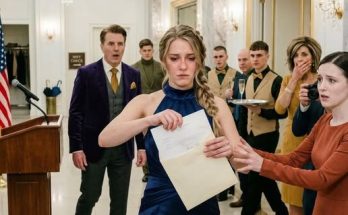
My Stepfamily Erased My Mother’s Love—Then a Hidden Letter Revealed a Truth That Left Me Sobbing

I’m sixty-eight years old now, but sometimes, late at night, I still feel the cold weight of that rainy Tuesday in 1975.
I had just buried my mother, Martha, in a small cemetery outside Scranton, Pennsylvania. The earth was fresh and dark, and the trees had begun their slow autumn death, leaves falling like quiet tears.
I was twenty-two. Barely a woman, but suddenly exhausted by life.
My mother had married George Tillman when I was seven, two years after my real father died in a factory accident. George had two sons from a previous marriage, Bill and Tom, both older than me, both with eyes that never seemed to warm when I entered a room.
But Mama loved George. Or at least, I thought she did. She cooked his favorite pot roast on Sundays. She ironed his shirts with starch, the way he liked. She smiled, but her smiles were the quiet kind, the kind that almost apologizes for taking up space.
I see now, with the wisdom of age, that my mother was a woman who had learned to survive by making herself small. She had lost one husband tragically and woke up in a world where a woman alone with a child was a target for whispers and charity. George was safe. He was steady. He offered a roof and a name, and for that, she gave him her silence.
But she always, always watched me.
I didn’t notice it then. I was too absorbed in teenage nonsense—school grades, silly crushes, dreams of moving to New York City where I’d be a journalist. But now, when I close my eyes, I can see her standing in doorways, her gaze following me like a gentle hand I never felt.
She died of ovarian cancer. It was swift, merciless. Six months from diagnosis to the gray morning when she slipped away while I held her hand, her skin paper-thin, her wedding ring loose on her finger.
I was hollowed out. My mother and I had rarely exchanged the words “I love you.” In our household, love was a thing you did, not said. I understood her love in the way she remembered I hated mayonnaise on my sandwiches, or how she’d stretch a dollar to buy me a new coat while her own was patched. But still, a secret part of me hungered for the words.
At the funeral, George stood stoic, accepting condolences like a statue. Bill and Tom flanked him in dark suits, their faces unreadable. I sat in the front pew, alone in my grief, clutching a hymn book that my mother had once sung from with a quavering soprano.
Two days later, George called me into the living room. The will had been read. Everything—the house, the small savings account, my mother’s jewelry—was left to him. My mother had signed that will years ago, George explained, back when I was still a minor, and she must have always intended for him to care for me. But now, he said, things were different.
“You’re an adult, Rose. You can make your own way. The house belongs to me, and there’s no room for you here anymore.”
I stood frozen on the braided rug my mother had bought at a county fair.
Bill sauntered in, his arms crossed. “She never loved you, you know,” he said. “Mom—I mean, Martha—used to tell Dad that you were just baggage from her first marriage. She never saw you as real family. You were an obligation.”
My throat closed. I looked at George, seeking some denial, but he just turned away.
I didn’t have the energy to fight. Grief had wrung me dry, like an old dish rag. I packed one suitcase—clothes, a few photographs, a chipped ceramic angel my mother had kept on her dresser, the only thing Bill didn’t snatch away. I drove away in my rusted Chevy Nova, heading south, with no destination and a heart brimming with a pain I couldn’t name.
I found a room in Philadelphia, a cramped studio above a noisy bar. I got a waitressing job at a diner where the coffee was bitter but the regulars were kind. I started building a life from ashes, though every night I’d cry into my pillow, mourning not just my mother, but the idea that I’d ever been truly cherished.
Those were dark weeks. I’d go to the public library during breaks and stare at old family law books, wondering if I could challenge the will. But I had no money for a lawyer, and what proof did I have? Just a daughter’s instinct that my mother had loved me, an instinct now scarred by Bill’s vicious words.
One cold October night, the kind where the wind howls like a living thing, my landlady pounded on my door. I had a phone call. It was 2 a.m.
“Rose?” The voice was thick, wet, a stranger’s but hauntingly familiar. “It’s George. Please—please come here fast. Oh God, Rose, I need you to come to the house.”
He was crying. Wracking, desperate sobs.
“What happened? Is it Bill? Tom?”
“No, no, it’s… it’s something I found. Please, just come. I’ve done something terrible.”
The line went dead.
I borrowed my landlady’s car, a beat-up station wagon that smelled of mothballs, and drove three hours north through the Pennsylvania darkness. My mind raced. Had Bill been in an accident? Was George ill? Or was this some cruel trick to lure me back and humiliate me again?
The house stood exactly as I remembered it—a white colonial with a sagging porch, the maple tree I used to climb now bare. Lights blazed from every window, which was unsettling. My mother had always been so frugal with electricity.
George met me at the door. He looked a decade older. His eyes were red-rimmed, his shirt untucked, his hands trembling.
“In the living room,” he whispered.
I followed him, my footsteps echoing in the silent hall where my mother’s laughter once lived.
On the mahogany coffee table lay an open hope chest, the one my mother had kept locked in the attic since I was a child. I remembered asking about it once. She had said, “Someday, Rose, there will be treasures for you in there.” But after her death, Bill told me they’d sold it along with everything else.
George pointed with a shaking finger. Inside the chest, among old quilts and yellowed lace, sat a thick envelope, slightly yellowed, with my name written in my mother’s handwriting.
“I found it this afternoon,” George said, voice cracking. “Bill and Tom were cleaning the attic to sell the house. They opened the chest—
he lied to you, Rose. They never sold anything. They just didn’t want you here. I… I didn’t want you here. I was afraid you’d take what I thought was mine.”
He broke down, sobbing into his hands.
I picked up the envelope as if it were made of butterfly wings. Inside was a letter, five pages long, and a delicate gold locket.
I sat on the couch, my knees weak, and began to read.
“My dearest Rose,
If you’re reading this, I am gone. I pray this finds you well, and that you have not let the hardness of this world crush your gentle spirit.
I have so much to tell you, my darling, and so many years of silence to undo.
First, you must know that every word I am about to write is the truest I have ever spoken. You were never, ever an obligation. You were my greatest joy, the only pure light in a life that often felt very dark.
When your father died, a part of me died with him. He was the love of my youth, the man who taught me to laugh without fear. When he was gone, I had to find a way to keep you safe, to provide a roof and a family name. George was a good man then, or seemed so, and I convinced myself I could learn to love him. I gave him obedience and duty, but my heart, my dear girl, always belonged first to your father’s memory, and second, to you.”
Tears blurred the ink. I could hear her voice, that soft Pennsylvania accent, as if she were sitting beside me.
“I know I wasn’t the mother who said ‘I love you’ easily. I was raised by parents who thought such words weak. But every night, Rose, after you were asleep, I would come to your room and whisper it into the dark. I would press my hand above your heart and pray God would let you feel what my lips could not say.
I saved for you. Pennies, dimes, the dollar bills I tucked away in this hope chest. In the bank, there is a small account in your name—only a few thousand dollars, but it is proof that you were always in my thoughts. The locket inside belonged to your grandmother, my mother. It holds a picture of your father and me on our wedding day. Keep it close, and remember that you came from a love that was real, even if it was cut short.
As for George and his sons: I knew their hearts. I knew Bill’s cruelty, and Tom’s indifference. I stayed because I had nowhere else to go, but I never confided in them the depths of my love for you. They could not have understood it. They saw the world in terms of ownership, and I refused to let them own my secrets.
So I hid this letter, praying it would reach you. If you are reading it, then somewhere, somehow, truth has broken through.
My final wish is this: Live. Live fully, without the weight of my failures. Forgive me for not being stronger. And know, beyond all doubt, that you were the most beloved daughter any mother could ever hope for.
Yours forever,
Mama”
I don’t remember how long I sat there, the letter trembling in my lap. At some point, I looked up at George, who had collapsed into an armchair, his face buried in his hands.
“The account,” he whispered. “I checked. It’s real. Twenty-seven hundred dollars. It should be yours. I’ll sign whatever I need to.”
I should have felt rage. He had hidden this. He had let Bill laugh at me, let me walk away thinking I was unloved. But sitting there, holding my mother’s words, all I felt was a profound, aching relief. She had loved me. The silence had meant something else entirely.
I never got the chance to hear her say it aloud, but I had this letter, and that was more precious than any house.
In the following weeks, George transferred the account to my name and insisted I take the hope chest and its contents. Bill and Tom never apologized. I saw them only once more, at a grocery store years later, and I simply walked away. I had no energy for anger; my mother had taught me, even in death, that some battles aren’t worth fighting.
I used the money to enroll in a secretarial course, then later a journalism program. I built a career writing human interest stories for a small newspaper in Ohio. I met a kind man named David, a carpenter, who understood that I carried a letter in my purse wherever I went, and never asked why I cried on certain autumn nights.
I’m sixty-eight now. David and I have two grown sons, and a granddaughter named after my mother. Martha. I tell her stories about the grandmother she never met, and I say the words I never heard: “I love you, sweetheart.” I say them so often she probably takes them for granted. That’s fine. That’s the point.
Looking back, I understand my mother’s choices. She was a woman of her era, trapped by necessity, but she found a way to speak across the grave. The true inheritance she left me wasn’t a few thousand dollars or a locket. It was the knowledge that love can be quiet, hidden, even denied by the world, but never extinguished.
And to George? I forgave him. Not because he deserved it, but because hatred is a heavy thing to carry, and I’d carried enough for one lifetime.
So if you ever find yourself questioning whether you were loved, please remember this: some people love you with a voice, and some with a silence. Listen carefully. You might be surprised by what you hear when you finally quiet the noise of your own doubts.