
Part1: My husband divorced me, remarried his lover when I was 9 months pregnant, and said: “I couldn’t stay with a woman with a big belly like you.” He didn’t know that my dad owned a company worth $40 million.

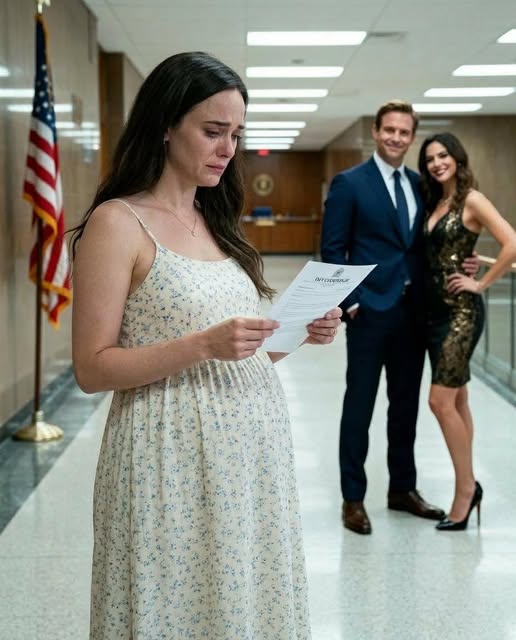
arrived. He looked… refreshed. Crisp navy suit. Hair perfectly styled.
The relaxed confidence people wear when they believe they’ve already won.
Standing beside him was a woman in a cream dress and high heels.
Her manicured hand rested on his arm like it belonged there.
Tessa Monroe.
I recognized her instantly.
She worked at Grant’s office.
The same coworker he once told me not to worry about.
The same woman whose “holiday party invitation” I skipped because Grant insisted I was “too tired to attend.”
Grant glanced at my stomach and grimaced.
Not concern.
Not guilt.
Disgust.
“I couldn’t stay with a woman with a big belly like you,” he said flatly.
The words carried farther than he probably intended.
Several people nearby turned to look.
“It’s depressing,” he added. “I need my life back.”
The baby kicked sharply inside me, as if reacting to the cruelty in his voice.
Tessa let out a soft laugh.
“Grant really tried,” she said sweetly. “But men have needs.”
My throat tightened.
“You’re divorcing me when I’m about to give birth,” I said quietly.
Grant shrugged.
“You’ll survive. My lawyer will arrange child support. I’m not your caretaker.”
Then he slid another document across the bench.
Glossy.
Official.
Marriage application receipt.
I stared at it.
“You’re marrying her?”
Grant smiled smugly.
“Next week.”
The baby shifted again, heavy and restless.
“You realize how this looks,” I said.
Grant leaned closer.
His voice dropped to a whisper only I could hear.
“You were a mistake,” he said coldly.
“And honestly? You never brought anything to the table.”
If he had shouted, I might have screamed back.
But the quiet certainty in his voice hurt more.
Because he believed it.
He believed I had nothing.
He believed I was nothing.
What Grant didn’t know was that my quiet father—the man who hated attention and lived in a modest house outside Dayton—owned a manufacturing company worth more than forty million dollars.
He also didn’t know that after my parents passed away two years earlier…
I had inherited it.
I never told Grant.
Not once.
And standing there in that courthouse hallway, watching him walk away with Tessa on his arm, I made myself a promise.
I wouldn’t beg.
I wouldn’t chase him.
I would rebuild my life quietly.
And if Grant Ellis ever crossed my path again…
He would finally understand exactly what he had thrown away.
Part 2
My son, Noah, was born three days later during a thunderstorm that rattled the hospital windows. Labor was long and brutal, and at one point I thought I might split in half. But when the nurse placed Noah on my chest—warm, squirming, alive—something inside me hardened into purpose.
Grant didn’t come. He didn’t call. The only message I received was from his attorney asking where to send the finalized divorce decree.
My dad arrived the next morning holding a bouquet that looked far too cheerful for the sterile hospital room. He didn’t ask questions at first. He just kissed my forehead and stared at Noah for a long time like he was committing him to memory.
Then he said quietly, “Tell me what happened.”
I told him everything. The courthouse. The insult. The new wife standing there like a trophy.
My father’s expression barely changed—he was the kind of man who handled anger the same way he handled business: silently and precisely. But his hand tightened around the plastic hospital chair until it squeaked.
“I’m sorry,” he said finally. “Not just for him. For me.”
I blinked. “For you?”
“I should have insisted you sign a prenup,” he said. “I let you believe love would be enough protection.”
I swallowed against the lump in my throat. “I didn’t want Grant to look at me differently.”
My dad nodded slowly. “He looked at you differently anyway. He looked at you like you were disposable.”
A week later, while I was still learning how to function on two hours of sleep, I received a notification that Grant had remarried. Someone from our old friend group posted photos online: Grant in a tux, Tessa in lace, champagne glasses raised, the caption: When you know, you know.
I stared at the screen until my eyes burned. Then I turned the phone face down and focused on Noah’s tiny face.
The next months blurred together with diapers, midnight feedings, and legal meetings. Grant’s lawyer tried to argue down child support by claiming his income had “changed.” He suddenly had a new car, a new condo, and a new wife with expensive tastes—but somehow, on paper, he was barely scraping by.
My dad didn’t interfere directly. He didn’t need to. He paid for a sharp family law attorney who wasn’t intimidated by polished suits. We documented everything. Enforced every deadline. Requested full financial disclosures. Eventually we secured a court-ordered support agreement that reflected reality, not Grant’s performance.
Still, I didn’t tell Grant who my father was.
Not as strategy. Out of pride.
I took a part-time remote admin job with a small nonprofit. I moved into a modest apartment. I let my life appear smaller than it really was because I wanted to prove I could survive without leaning on my dad’s money—even if it existed.