“Are you sure about what you’re saying?” she whispered, praying it was merely a mistake—a passing scare.-olweny

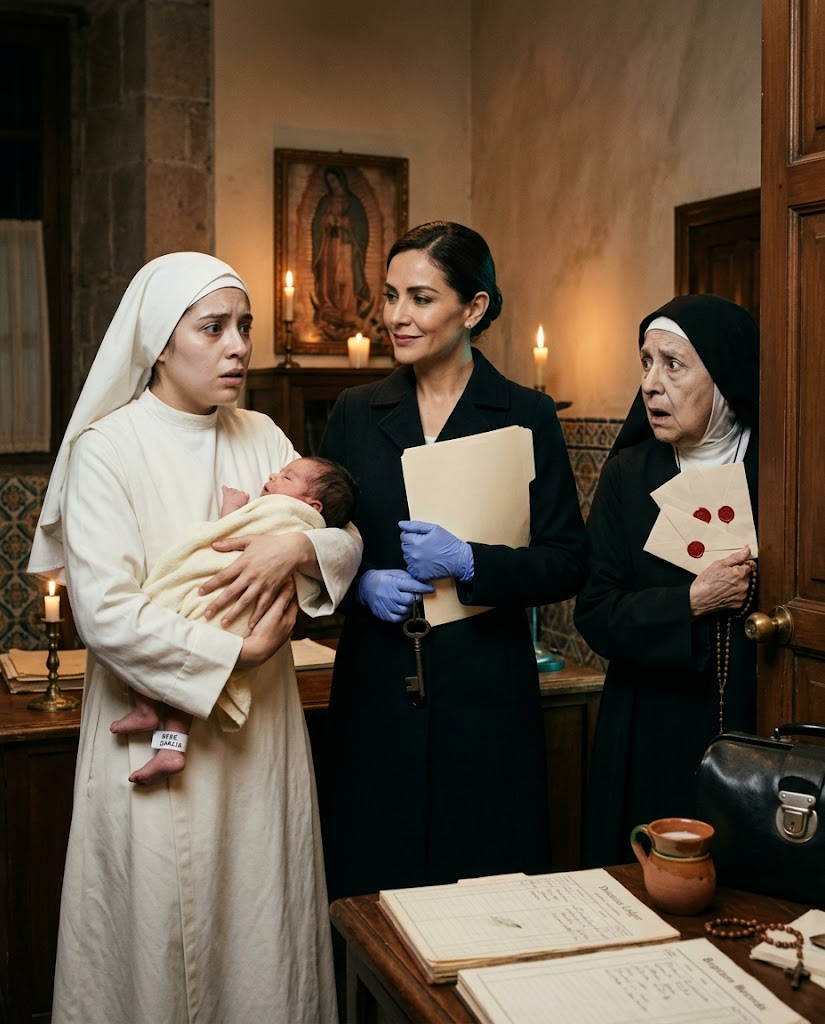
The medical tape finished peeling off as Dr. Paloma raised the key to the crypt.
The black ink first appeared as a crooked smudge in the yellow candlelight. Then two letters formed. Then a surname.
“Charity Salgado”.
My name.
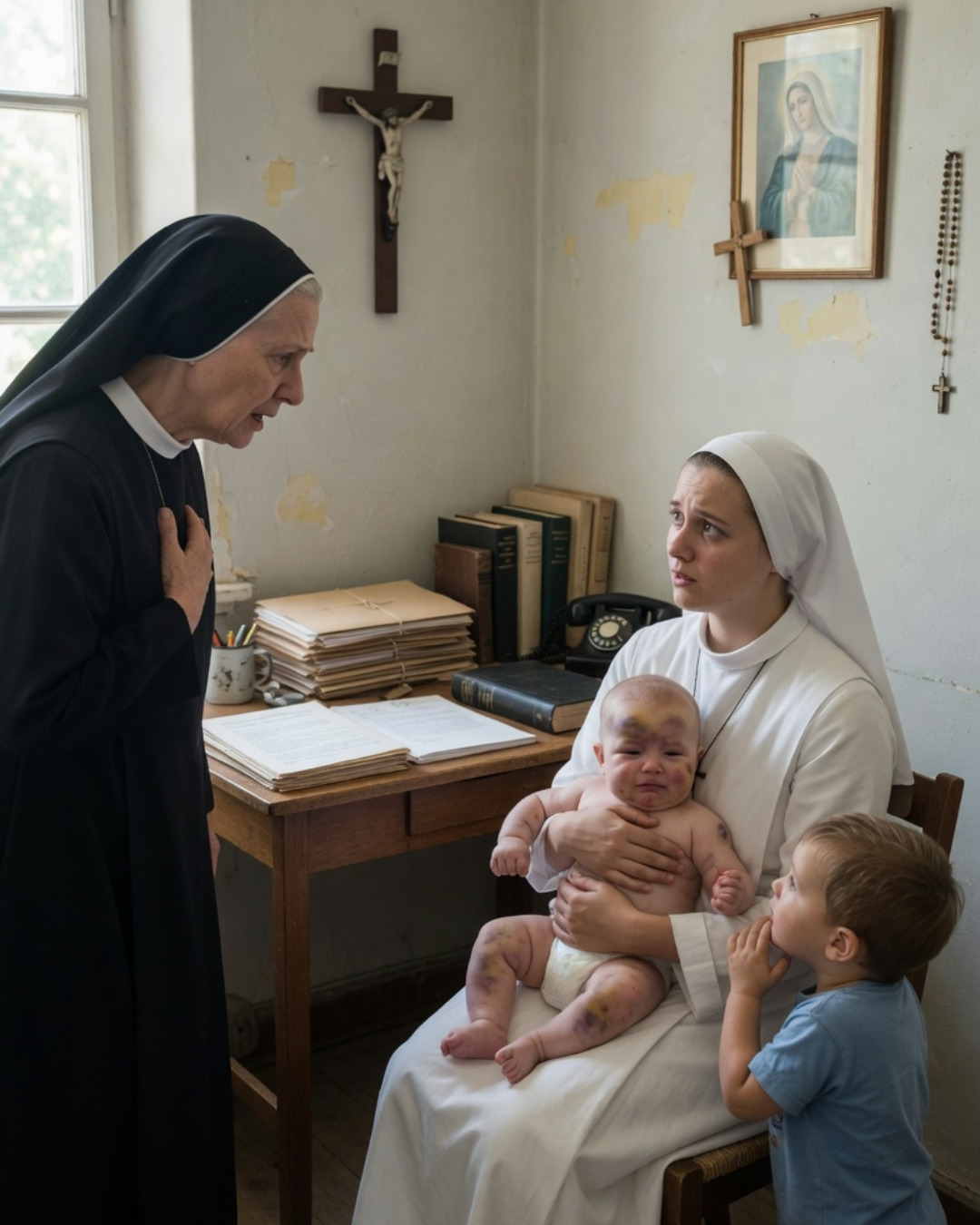
The baby cried with his mouth open, his face red, his fists clenched under the blanket. Sister Esperanza didn’t understand. Her eyes darted from the child’s ankle to my face, from my face to Dr. Paloma, as if she were still searching for a pious explanation in the middle of that office that smelled of sweet medicine and old wood.
“Mother…” Esperanza whispered. “Why does the baby have your name?”
Paloma didn’t answer. She barely smiled, like someone listening to a child’s question.
I took a step back, the envelopes pressed against my chest. The red wax cracked beneath my fingers. The key to the crypt gleamed in the doctor’s hand, and behind her, in the corridor, Sister Consuelo stood motionless, the spoon on the floor.
That was the first witness.
Consuelo didn’t scream. She didn’t run. She didn’t pray. She stood there, her face white, one hand resting on the doorframe, staring at the baby, then at the cream-colored folder, then at Paloma. Her lips moved twice before a word came out.
-It just can’t be.
Paloma slowly turned her head.
—Sister Consuelo, go back to the kitchen.
But Consuelo didn’t move.
Behind her appeared the second witness: Julián, the young man who every Tuesday delivered sacks of beans, rice, and soap donated by the San Ángel parish. He still had the receipt folded between his fingers. His gaze fell to the open medical bag, the used gloves, the folder with my forged stamp.
The blood drained from his face.
—I didn’t see anything—Paloma said calmly, before he could speak—. And neither did you.
Julian swallowed hard. The receipt trembled in his hand.
“The front door was locked,” he murmured. “I came in through the kitchen because Sister Consuelo asked me for help with the sacks.”
Paloma let out a small laugh.
—How convenient.
I looked down at the envelope that read “Family coffin, north crypt.” The wax seal was broken. Inside was an old, yellowed photograph, taken in the convent courtyard. It showed an elderly woman in a white habit, long before I became Mother Superior. On the back, written in blue ink, I read: “Mother Inés. First objection. Buried without registration.”
The air grew thick.
—You said that the first mother who asked questions was there—I told Paloma.
She lifted her chin.
—And it’s still there.
Esperanza pressed the baby to her chest.
—What did they do to me?
Paloma looked at her as if the young nun were just another piece of furniture in the office.
—They gave him shelter, food, and purpose.
“What did they do to me?” Esperanza repeated, this time more quietly.
The doctor closed the briefcase with a sharp click.
—Don’t complicate things. Your children are healthy.
The phrase landed in the room like a stone.
Consuelo covered her mouth. Julián took a step back and bumped into a chair. The little boy, Miguel, woke up at the noise and began to cry too, clinging to Esperanza’s habit.
I opened the second envelope. It contained copies of receipts, transfers, and handwritten notes. “San Ángel Lot — PV” appeared again and again. Every supposed donation for medicine, paint, roof repairs, or food had the same origin: a private clinic with no visible sign, registered under the name of a foundation.
Pure Life Foundation.
PV
Paloma Vázquez.
—You created the foundation—I said.
Paloma sighed, as if I were tiring her out.
—I organized what you didn’t know how to manage.
—Babies?
—Opportunities, Mother.
Esperanza let out a sound that was neither a cry nor a scream. It was something breaking as it left her body.
—My children are not opportunities.
Paloma looked at her for the first time with annoyance.
—Without me, you would have been just another nun hiding behind a wall.
Then the phone on my desk rang.
Nobody breathed.
The old device vibrated on the wood next to the rosary. Once. Twice. Three times.
Paloma looked down at the number. Her smile disappeared.
I recognized the area code before I picked up the horn.
—Mother Caridad—said a male voice—. This is Ernesto Robles, Esq., from Public Notary Office 42. We received your emergency envelope at 10:05. Are you alone?
I looked at Paloma.
-No.
The doctor pressed the key to the crypt.
—Hang up.
Attorney Robles remained silent for half a second.
—Then the clause is activated.
Paloma took a step towards me.
I raised my hand.
—Don’t come any closer.
She smiled again, but it wasn’t the same smile. It had a crack in it.
—What did you do, Mother?
I didn’t answer immediately. I let him hear the notary’s voice on the other end of the line.
—The Investigative Police have already received a copy of the documents, Mother. So has the Prosecutor’s Office. And the Public Ministry of Coyoacán.
Julian opened his eyes.
Consuelo began to pray silently.
Paloma remained still.
For three years, everyone had believed I was a naive old woman with keys at my waist and faith in stamped documents. That suited the doctor. That suited the benefactors who arrived in black vans, left envelopes of money, and never asked why a young nun was pregnant again.
But I was born Caridad Salgado before I took the veil. My younger brother had been a public prosecutor. He died nine years ago, but before he died he taught me one thing: when a powerful person seems untouchable, you don’t confront them with courage. You surround them with evidence.
That’s why I kept every receipt.
That’s why I copied every signature.
That’s why I changed the rosary on my desk for a hollow one, with a small memory hidden in the cross.
Paloma followed my gaze towards the rosary.
-No.
I took the cross between my fingers.
—Ever since he said, “faith covers what the law should not look at.”
The doctor’s face lost its composure for the first time.
—You nosy old woman.
—That was also recorded.
Footsteps were heard in the hallway. Loud. Several. Then knocks on the main door of the convent.
—Investigative Police!
Esperanza hugged her children so tightly that the baby stopped crying for a moment. Miguel hid his face in her skirt. Consuelo moved away from the doorway as if her legs had finally remembered how to move.
Paloma looked out the window.
Julian stood in front of her.
He was a thin boy, wearing a denim shirt, with hands that looked like they carried sacks, but at that moment he didn’t tremble.
—It’s not going to come out that way, doctor.
Paloma looked him up and down.
—Get out of the way.
-No.
The front door shook again.
I opened the third envelope, the one with Esperanza’s name on it. Inside was an incomplete birth certificate, a list of initials, and a recent photo of the north crypt. The picture showed an old coffin, barely open, with a bag of sealed documents inside.
It wasn’t a corpse that Paloma had protected underground.
It was the complete archive.
Mother Inés hadn’t disappeared because she asked questions. She had hidden the first clues before she died. Paloma had used her tomb as a safe because, she thought, no one would dare touch a coffin inside a convent.
“The crypt,” I said into the phone. “Tell them to go to the north crypt.”
Paloma lunged towards me.
He didn’t arrive.
Consuelo grabbed his arm from behind. Julián snatched the key from his hand. The doctor struggled, now without elegance, without any air of authority. The folder fell to the floor and opened. The papers scattered under the desk: forged consent forms, invoices, initials of wealthy families, cash payments, names of clinics, delivery dates.
Hope saw one of the leaves.
His name appeared written twelve times.
“I didn’t sign that,” he said.
“I know, daughter,” I replied.
And that was the first time she believed me without asking for an explanation.
When the officers entered, Paloma tried to regain her calm voice.
—I’m a doctor. You’re making a mistake.
An agent in a dark jacket looked at the baby, then at Esperanza, then at the leaves on the ground.
—Dr. Paloma Vázquez, you are detained to testify regarding forgery, deprivation of rights, trafficking of medical documents and whatever else may result.
“They have no idea who has my back,” Paloma said.
I picked up one of the leaves.
-Now yes.
The agent took the folder.
Paloma fixed her eyes on me as they put the handcuffs on her. She wasn’t smiling anymore. Her mouth was barely trembling.
—You’re not going to survive this, Mother.
Esperanza, still pale, took a step forward with the baby in her arms.
—She is not alone.
Nobody spoke for several seconds.
Outside, rain began to fall on the bougainvillea-covered patio. The smell of wet earth drifted in through the broken window. The candles before the Virgin of Guadalupe flickered as if the air, too, were weary.
The north crypt opened at 11:37 pm.
I didn’t go down alone. The agent, Julián, and Consuelo came with me. The underground passageway smelled of damp stone and old flowers. Each step creaked under my shoes. At the far end, Mother Inés’s coffin waited, covered in dust.
The agent carefully lifted the lid.
There were no remains inside.
There were boxes.
Boxes with women’s names. Boxes with receipts. Boxes with baby photos. Boxes with letters that never reached their recipients.
Above each of them was a note written with the same blue ink as the old photograph:
“If Caridad finds this, believe her. I couldn’t save them. She can.”
Consuelo burst into tears.
I couldn’t.
My eyes went dry, fixed on those letters of a dead woman who had waited years underground for someone to finish what she started.
At dawn, Paloma was taken away. The San Ángel clinic was also sealed, and a warrant was issued to search other properties linked to the foundation. Esperanza and her three children were moved to a secure room inside a convent in Puebla. She refused to let anyone take the newborn from her arms, not even to change his blanket.
Before leaving, he handed me the medical tape.
“Why did it have his name?” he asked me.
I looked at the black ink.
Charity Salgado.
It was not a proprietary firm.
It was a threat.
Paloma had marked the baby with my name because she planned to bury me in the crypt and blame me for everything. The fake folder, my seal, my supposed authorizations, the prepared envelopes: every piece was ready to transform Mother Caridad into the woman who sold the convent’s silence.
Esperanza’s youngest son had not arrived to close the secret.
He had arrived as bait.
And I almost took the bait.
That afternoon, when the convent was empty of patrols, I went into the office alone. The chair was still turned upside down. Paloma’s briefcase was gone. On the floor lay a dry drop of red wax, broken in two like a shattered seal.
I picked up the rosary from the desk.
The hollow cross weighed less without the memory inside.
On the wall, the Virgin of Guadalupe was still tilted, the frame warped from the morning’s impact. I straightened it with both hands. Then I looked toward the hallway where Esperanza had first said, “I think I’m pregnant. Again.”
There was no crying.
No key clicked.
All that remained was the empty crib by the window, the folded medical tape on the desk, and an unlit candle in front of the Virgin, leaving a trail of black smoke that slowly rose until it disappeared into the ceiling.

Related posts