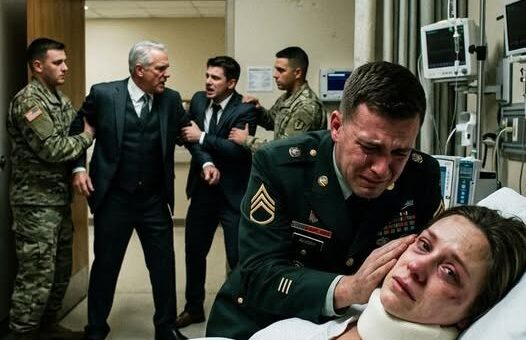
I was chopping vegetables when my four-year-old daughter pulled my arm and asked me softly

I was chopping vegetables when my four-year-old daughter pulled my arm and asked me softly: “Mommy… can I stop taking the pills Grandma gives me every day?” I felt my blood drop to the floor, because my mother-in-law had been living in my house for three weeks, and I believed she was only giving her vitamins. The knife fell onto the cutting board. Emma started crying without making a sound. And from the living room, my mother-in-law suddenly turned off the television.
My name is Mariela.
Until that afternoon, I thought my worst mistake had been letting Diane, my mother-in-law, move into our apartment “only while she recovered from her knee.”
Three weeks.
That was what she had promised me.
Three weeks to rest, use a cane, drink tea, and watch soap operas.
But Diane did not rest.
She watched.
Corrected.
Meddled in everything.
“That girl needs routine.”
“Young mothers drown in a glass of water.”
“I already raised children, mija. I know what I’m doing.”
I clenched my teeth and stayed quiet.
My husband, Andrés, always said the same thing:
“Be patient with her. She’s my mother.”
And I was patient with her.
I allowed her to comb Emma’s hair.
I allowed her to read her stories.
I allowed her to prepare her snack.
I allowed her to give her “vitamins” every morning, because I saw a bottle of children’s gummies in the cabinet and did not ask more questions.
That was my sin.
Trusting.
Emma was four years old.
Huge eyes.
Brown curls.
A laugh that used to fill the house.
But ever since her grandmother arrived, my little girl began to change.
She slept too much.
She stared at the wall.
She left food on her plate.
She tripped over her own feet.
And when I asked what was wrong, Diane answered before she could.
“She’s growing.”
“She’s tired.”
“She’s finally behaving calmly.”
That word scraped me inside.
Calm.
As if my daughter were a problem that had to be turned off.
That afternoon, I was making zucchini in the kitchen when Emma appeared behind me.
She did not come running like always.
She came barefoot, with her stuffed bunny pressed against her chest and her little face pale.
She pulled my sweater.
“Mommy…”
I crouched down.
“What happened, love?”
She looked toward the living room.
Then toward the hallway.
Then she brought her mouth close to my ear.
“I don’t want to take the pills Grandma gives me every day anymore… can I stop doing it?”
The world went silent.
Not the pot.
Not the street.
Not my own breathing.
Only that sentence.
Pills.
Every day.
I knelt in front of her and took her little hands.
“Emma, my love, what pills?”
Her little eyes filled with fear.
“The ones she says are so I won’t be bad.”
I felt like vomiting.
“You’re not in trouble,” I told her, though my voice came out broken. “You did very well telling me. I need you to bring me the bottle, okay?”
Emma shook her head.
“Grandma said that if I told you, you would get sick because of me.”
I pressed my lips together so I would not scream.
“Go get it, my little girl. I’m right here.”
She ran to the hallway.
I stayed alone in the kitchen, my hands on the table and my heart pounding in my throat.
Then I remembered everything.
The long naps.
The dull eyes.
Diane’s phrases.
“I gave her vitamin early today.”
“She’s drowsy, good, that way she rests.”
“With you, she was tantrum-prone. With me, she understands.”
Emma came back with an orange pharmacy bottle in both hands.
As soon as I saw it, my legs folded.
They were not vitamins.
It was adult medication.
With a medical label.
With a marked dose.
And below, printed in black letters, was my mother-in-law’s name:
Diane Patterson.
I did not call Andrés.
I did not call Diane.
I did not ask permission.
I put the bottle in my bag, took Emma in my arms, and left through the back door of the building as if I were going to take out the trash.
I took her straight to her pediatrician.
During the drive, Emma sat in the back hugging her bunny, looking at me through the mirror.
“Is Grandma going to get angry?”
“It doesn’t matter.”
“She said Daddy believes her more.”
My eyes burned.
“It doesn’t matter,” I repeated.
The doctor received us as an emergency.
He was a calm man with gray hair, who always spoke softly so he would not scare children.
I handed him the bottle.
At first, he took it like someone expecting a misunderstanding.
But when he read the label, his face changed.
He read it once.
Then again.
Then he looked at Emma.
“How many did she give her?”
“I don’t know,” I said. “My daughter says every day.”
The doctor placed the bottle on the table as if it burned.
“Mariela, I need to examine her now. And I need you not to return to that house tonight.”
I felt a chill down my back.
“What is it?”
He did not answer immediately.
He called a nurse.
He ordered tests.
He asked them to close the door.
He asked to speak with me away from Emma.
Then my cell phone started vibrating.
Andrés.
I did not answer.
It rang again.
Then a message arrived.
“My mother says you took Emma out without telling anyone. Come back now.”
The doctor read my face.
“Does your husband know you’re here?”
I shook my head.
Before I could put the phone away, another message came in.
This time, it was not from Andrés.
It was from Diane.
“I know where you are. Don’t let them draw her blood.”
My hands went weak.
The doctor took the phone, saw the message, and lowered his voice.
“Mariela, listen to me carefully. This is no longer a family problem.”
I looked out the clinic window.
On the sidewalk, in front of the clinic, my husband’s car had just parked.
Diane was in the passenger seat.
Without a cane.
Without limping.
Smiling.
And Emma, from the examination table, whispered in terror:
—Mommy… don’t let Grandma in.
It wasn’t a scream.
It was worse.
It was a whisper from a little girl who had already learned that asking for help too loudly could bring punishment.
I lifted her from the stretcher and held her close to my chest. Emma was warm and limp, her eyes bright, and she clutched her stuffed bunny tightly between her fingers. Outside, I heard Andrés’s voice in the reception area.
—I am her father. My daughter is in there.
And then Diane’s voice, soft, perfect, poisonous.
—Mariela always does this. She gets scared, she dramatizes, she invents enemies. Doctor, please, just let us take the girl home.
The pediatrician locked the door.
—Mrs. Mariela, listen to me. Don’t go out. Don’t hand the girl over. I’ve already asked for help.
-Support?
—Social work and emergencies.
I felt like I was running out of air.
—What did he give her?
The doctor looked at the orange bottle inside a transparent bag.
—This medication is not appropriate for a four-year-old girl without a strict indication. It can cause drowsiness, incoordination, confusion, and respiratory problems depending on the dose. We need further studies.
I covered my mouth.
The word “breathing” pierced me like a knife.
Emma lifted her face.
—Mommy, am I going to die?
—No, my love. No.
I said it with a certainty I didn’t have.
The doctor crouched down in front of her.
—Emma, you did the right thing by telling your mom.
She looked at him suspiciously.
—Grandma says that doctors give injections to naughty girls.
“There are no bad girls here,” he replied. “Only brave girls.”
Then Diane knocked on the door.
Not strong.
Three sharp knocks.
Like someone who doesn’t ask for permission, he demands it.
—Mariela, open up right now.
Emma shrank so much that she almost disappeared into my arms.
Andrés spoke behind her.
—Mariela, don’t make this worse.
I approached the door without opening it.
—Worse than secretly medicating my daughter?
There was silence.
A short silence.
Then Diane let out a little giggle.
—Oh my God. Did she tell you that? She’s four years old. She makes things up.
Emma began to cry silently.
I covered one of his ears with my hand.
—I have the bottle.
“You stole it from me,” Diane said.
The doctor looked at the door.
That sentence was enough.
The nurse entered through a side door of the office, accompanied by two municipal police officers whom the staff had called by 911. In Jalisco, the number 911 is used to report emergencies and request security support or medical services, and that afternoon it ceased to be a number posted on signs and became the line between my daughter and the house where they were turning her off.
We opened the door.
Diane’s expression changed as soon as she saw the police officers.
First surprise.
Then offense.
Then a calm so calculated it made me nauseous.
—Officers, my daughter-in-law is having an episode. I’m a retired nurse.
It wasn’t.
I had never been a nurse.
She had worked for twenty years in a fabric store in Chicago before coming to Mexico when Andrés and I got married.
Andrés approached me.
—Give me Emma.
I looked at him as if he were a stranger.
-No.
—I am his father.
—Then act like it.
Her face tensed.
Diane put a hand on her chest.
—Andrés, say something to her. She’s upset. Look how she’s scaring the girl.
Emma raised her head.
—Daddy… I don’t want to go with Grandma.
Andrés remained motionless.
For the first time in weeks, Diane did not respond for her on time.
“What did you say, princess?” he asked.
Emma swallowed.
—I don’t want pills.
Andrés looked at the bottle in the doctor’s hand.
Then he looked at his mother.
-Mother.
Diane sighed, as if we were all fools.
—I was giving her a minimal dose. The girl was unbearable. She wouldn’t sleep, she wouldn’t obey, she threw tantrums about everything. Mariela doesn’t know how to set limits.
The doctor straightened up.
—That doesn’t give him the right to medicate a minor.
—I raised three children.
—And yet he’s not his patient.
Andrés took a step back.
It wasn’t enough.
I wanted to see it break.
I wanted to see him stand in front of us.
I wanted her to not say “my mom” as if that phrase were law, for once.
But he just stood there, pale, staring at the bag with the medicine.
One of the police officers asked us to go for a hospital evaluation. Diane wanted to come with us. The nurse intervened.
—The minor will travel with her mother.
—I am the grandmother.
—That’s exactly why.
That phrase sustained me.
They took me to the Fray Antonio Alcalde Civil Hospital in Guadalajara. As the ambulance wound its way through streets choked with traffic, food stalls, and trucks that seemed to never stop, I hugged Emma and counted her breaths. The old Fray Antonio Alcalde Civil Hospital is a hospital located in the city, on Hospital Street, and that night its name stuck with me as the first place where someone stopped calling me a drama queen.
Emma was asleep, but not like before.
Not like those heavy naps that Diane used to enjoy.
She slept restlessly, wrinkling her nose, searching for my blouse with her fingers.
“I’m here,” he kept repeating. “I’m here.”
Andrés arrived behind us.
His mother was with him.
Without a cane.
Without limping.
With the firm steps of a woman who was never sick.
I saw her enter the pediatric emergency room hallway and felt like something inside me was closing forever.
Three weeks.
Three weeks of faking knee pain to move into my house.
Three weeks observing what time I cooked, when I showered, where I kept the keys, when Emma was alone with her.
Three weeks of saying “it’s for your own good”.
It wasn’t helpful.
It was an invasion.
We were separated for interviews.
A doctor examined Emma.
A social worker asked me to tell everything from the beginning. As I spoke, I realized how absurd it sounded and how obvious it had been.
Naps.
Clumsiness.
The dull gaze.
The fear of being left alone with Diane.
The phrase: “so that it is not bad”.
I cried when I told her.
The social worker didn’t interrupt me. She just wrote.
Then she explained that the Office of the Attorney for the Protection of Children and Adolescents of the Jalisco DIF (National System for Integral Family Development) handles and refers cases of abuse, issues protection orders, and accompanies children and adolescents before administrative and judicial authorities. I could barely process the words, but I understood one thing: that night we no longer depended on Andrés believing me.
At midnight, Emma woke up.
Her lips were dry and her eyes were swollen.
—Mommy.
-Here I am.
—Is Grandma outside?
—You cannot enter.
-Really?
-Really.
He looked towards the door.
—He said that if I said anything, you were going to go to a crazy moms’ house.
I felt such a deep cold that not even the blanket could take it away.
—When did he say that?
Emma moved her fingers over the sheet.
—When you were washing dishes. She said that Daddy would believe her, because she took care of him when he was a baby and you only came later.
I turned towards the door.
Andrés was standing there.
I had heard everything.
Her face no longer showed confusion.
I was ashamed.
—Emma —he said, his voice breaking—, did Grandma give you the pills even though you said no?
My daughter hid behind me.
—She said it was a good girl secret.
Andrés covered his mouth.
I didn’t feel sorry.
I felt rage.
—Your daughter had to save herself because you didn’t want to upset your mother.
—Mariela…
-No.
-I did not know.
—You didn’t want to know. There’s a difference.
He remained silent.
Good.
For once.
At two in the morning, the police asked to search the apartment. Andrés handed over the keys without looking at me. Diane protested in the hallway, raising her voice in English and Spanish, saying that in her country no one would treat a grandmother like that.
An agent replied:
—In any country, medicating a child without authorization is serious.
Diane glared at her with hatred.
That’s when his mask fell off.
—That girl needed discipline.
I left the room.
The officer tried to stop me, but I got close enough for Diane to hear me.
—My daughter needed a grandmother. Not a jailer.
Diane smiled slightly.
—You were never enough for Andrés. Nor were you ever going to be enough for her.
Andrés raised his head.
—Mom, shut up.
She turned towards him, as if she had betrayed him.
-Sorry?
—Shut up.
It was small.
Late.
But it was the first crack.
The department review uncovered more than I imagined.
A notebook in Diane’s drawer.
Schedules.
Dose.
Comments.
“7:20 — half an hour before breakfast.”
“13:00 — if she cries.”
“5:30 p.m. — before A arrives.”
“I’m tired. Provoke her.”
“M must appear unstable.”
M was me.
A was Andrés.
They also found printed emails with a lawyer’s name on them. Diane had asked how to document “maternal neglect,” how to request temporary custody for the father, and how to record “erratic behavior by the mother.”
Everything was planned.
Diane didn’t want to reassure Emma.
He wanted to destroy me using my daughter’s body as proof.
When the agent showed me the copies, I had to sit down.
Emma slept in the hospital bed, with a sensor on her finger and the bunny under her chin.
“He wanted to take my daughter away from me,” I whispered.
The agent nodded.
—It seems so.
Andrés read the notebook afterwards.
She didn’t cry at first.
He turned white.
Then he began to tremble.
—My mom doesn’t…
It didn’t end.
Just because.
Yes, her mom did.
And the worst part wasn’t discovering that Diane was capable.
The worst part was accepting that he had opened the door for her.
We stayed at my sister Rebeca’s house in Tlaquepaque after Emma was discharged from the hospital. Rebeca greeted me with a blanket, hot broth, and that quiet fury women feel when one of their own arrives carrying a broken child.
“Nobody gets in here without me biting them,” he said.
Emma fell asleep on a mat next to my bed.
Before closing his eyes, he asked:
—If I’m noisy, will you give me a pill?
I lay down next to him.
—If you’re noisy, we’ll sing.
—What if I get angry?
—We breathe.
—Am I bad?
I took his face in my hands.
—You’re not bad, Emma.
Her lip trembled.
—Grandma said yes.
—Grandma was lying.
He was left thinking.
—Daddy too?
That question hurt me more than any blow.
—Daddy didn’t look when he should have looked.
She didn’t fully understand.
I do.
The next day, the Attorney General’s Office issued protective measures. Diane was prohibited from approaching Emma or communicating with us. Andrés could only see the girl under supervision while his omission and the documents he had signed in favor of her mother were being reviewed.
Just because.
I had signed.
A letter authorizing Diane to pick up Emma from school and make decisions “in case of maternal crisis”.
She showed it to me one afternoon, with swollen eyes.
—He told me it was in case something happened to you.
—She was passing me.
He did not respond.
—Andrés, your mother didn’t get into our house by breaking a window. She got in because you gave her a key.
He broke down.
-I know.
I didn’t hug him.
Just because someone is crying doesn’t mean you have to carry them.
Weeks of analysis, statements, and therapy passed.
Emma started to draw.
First, a little girl asleep in a huge bed.
Then a door.
Then a woman standing outside.
One day he drew that woman entering.
The therapist told me not to pressure her.
I learned to wait.
I also learned not to correct my daughter’s fear as if it were a tantrum.
When Emma checked her glass before drinking water, I didn’t say “it’s okay”.
It said:
—We’ll review it together.
When he asked if the food had pills in it, I showed him the pot.
When he woke up at three in the morning, touching his tongue, I would sit next to him and say:
—Your body is yours. Nobody gives you anything without your mom knowing.
The first time she laughed loudly again, Rebecca and I froze.
Emma was in the yard, chasing my sister’s dog with a red ribbon. She tripped, fell on her bottom, and started laughing hysterically. Then she suddenly covered her mouth, startled by the noise she’d made.
—Did I do wrong?
I put down the clothes I was folding and picked them up.
—No, my love. You made noise.
-And so?
—That’s life.
I cried when he didn’t see me.
Diane was formally charged months later. She arrived at the hearing with a cane, a pearl necklace, and the face of a misunderstood grandmother. Again with the cane. Again with the play.
The prosecutor presented the jar, the notebook, the messages, the analyses, Emma’s statement, and the emails to the lawyer.
Diane cried when it suited her.
“I just wanted to help. Mariela hates me because I’m a foreigner. She doesn’t understand my parenting style.”
My lawyer, a petite woman named Laura Medina, stared at her without blinking.
—Does your parenting style include giving adult medication to a four-year-old girl to make her appear neglected?
Diane shut her mouth.
Andrés made that statement that day.
I didn’t expect anything from him.
But he stood up, looked at the judge, and said:
“My mother hurt my daughter. I didn’t stop her because I was used to obeying her. That hurt too.”
Diane lost control.
—After everything I did for you!
Andrés cried.
—That’s exactly what I’m starting to understand.
I did not forgive him.
But I listened.
Which is not the same thing.
We moved to a small apartment near Agua Azul Park. It wasn’t fancy, but it had morning light and a window where Emma put a pot of basil. Agua Azul Park, in Guadalajara, is on Calzada Independencia and is one of those old places in the city where trees, paths, and memories of families walking in the shade still remain.
We used to go there on Sundays.
Emma looked at the plants, the birds, the children running.
At first it stayed stuck to my leg.
Then he would let go of my hand for a few steps.
Then he would return.
I was always there.
That was the new language of our house.
I’m.
I’m here if you scream.
I’m here if you cry.
I’m here if you ask.
I’m here if you’re afraid to sleep.
Andrés started therapy and requested supervised visits. The first time he saw Emma at the supervised visitation center, he didn’t try to hug her. He sat far away, with a storybook in his hands, waiting.
Emma watched him for a long time.
“Did you know?” he asked.
He swallowed.
—Not at first. Then I saw strange things and I didn’t ask because I was afraid of fighting with my mom. That was wrong.
Emma looked at her red shoes.
—I was afraid and I said.
Andrés closed his eyes.
—You were braver than I was.
She nodded, serious, as if she already knew that.
Then he told her the story.
—Read, but don’t do ugly voices.
He let out a broken laugh.
-Alright.
I saw them from the chair next to me.
I felt no tenderness.
I felt watched.
And that was love too.
A year later, Emma no longer asked if she could stop taking pills.
She asked if she could wear boots with a dress, if she could sing in the bathtub, if she could put too much cinnamon in the rice pudding.
I almost always said yes.
And when I told him no, I explained why.
Because I learned that boundaries don’t have to sound like a threat.
They may sound like a warning.
Diane went far away.
His name still appeared on papers, summonses, and hearings, but no longer on my daughter’s lips before going to sleep.
One afternoon, Emma opened the drawer where I kept documents and found an old photo: her, Diane and Andrés in the living room, weeks before everything.
He stared at her.
—Was Grandma always mean?
I sat down next to her.
—I don’t know if it was always like that. But he did some bad things.
—And was I bad?
I felt like my chest was breaking.
—No, Emma. You were a child making noise. And children have the right to make noise.
She thought for a moment.
Then he tore the photo in two.
Not with anger.
With determination.
He handed me the half where Diane was.
—She doesn’t live here anymore.
I put the piece in an evidence bag, along with the orange jar, the copies, and the notebook.
Not out of morbid curiosity.
For the memory.
Lest we forget that danger doesn’t always come screaming.
Sometimes he comes in with a suitcase, a bandaged knee, and phrases like “I know what I’m doing.”
Now my house has rules.
Nobody gives Emma medicine without my knowledge.
Nobody calls her bad.
No one speaks for her if she can speak.
And nobody confuses tranquility with forced obedience.
My name is Mariela.
I am Emma’s mom.
I no longer live where Diane abruptly turned off the television.
I no longer confuse patience with silence.
I no longer let a woman with a grandmother’s smile decide how much noise my daughter can make to deserve love.
Every morning, Emma wakes up with messy curls and too many questions.
I prepare eggs, open the windows, and let her voice fill the apartment.
Let her sing.
Let him get angry.
Let him ask.
Let him be wrong.
Long live.
Because a house where a girl can make noise without fear is not disorder.
It’s justice.