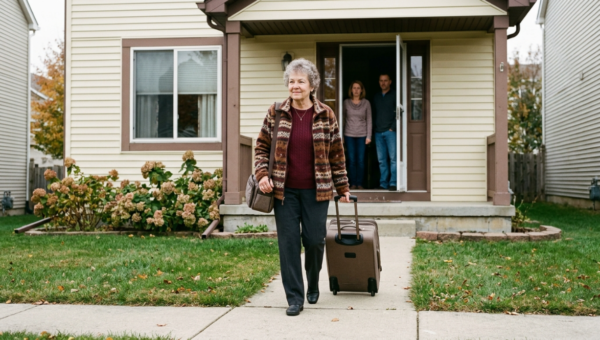
My daughter told me to serve her husband or leave. I packed my bags.

“Either you help Harry and do what he asks, or you pack your things and leave.” My daughter Tiffany said it so calmly, standing there with her dish towel, while her husband grinned from my late wife’s favorite leather recliner. I didn’t say a single word. I just went upstairs, pulled my old suitcase from the closet, and began to pack. They thought I would give in like I always did. They thought an old man retired in Kalispell, Montana, had nowhere else to go. But they forgot one simple detail. I spent thirty years as a commercial loan officer at the bank. I knew exactly whose name was on the deed of that house.
I did not shout. I did not argue. I did not slam anything against the counter. And I did not remind her, at least not then, of every bill I had paid in silence, every bag of groceries I had carried into that house, and every piece of my retirement I had sacrificed because I thought that was what a father did. I only smiled. Then I picked up my suitcase and left the house I had spent my whole life paying for.
She expected me to calm down, apologize, step into the kitchen, and do whatever her husband demanded just to keep the peace. But that Saturday afternoon, something inside me finally became quiet.
My keys were still warm in my hand when I had come through the front door earlier that afternoon. Grocery bags dug into my wrists. Soft spring sunlight slipped through the living room curtains and stretched across the hardwood floors Martha and I had refinished together two decades earlier. Outside, a neighbor’s flag stirred in the mountain breeze. A lawn mower buzzed somewhere down the street, steady and ordinary, as if my life was not about to change.
Inside my house, Harry was sprawled in my leather recliner. Not just any chair. Martha had given me that recliner before cancer took her. It was the last birthday present she ever bought me. I used to sit there at night with coffee in my hands, listening to the quiet house and imagining she was still moving around in the kitchen.
Now my son-in-law had his feet propped up in it like the place belonged to him. A half-empty beer bottle hung from his fingers. The basketball game blasted through the room, and the remote sat on his stomach like he was king of the house. He did not even turn his head.
“Old man,” he said, still watching the screen, “bring me another beer from the fridge while you’re standing.”
I lowered the grocery bags to the floor. The milk and bread landed with dull thuds. The plastic handles had already carved red lines into my palms. “Excuse me?” I asked.
“You heard me,” Harry said. “Corona. Not that cheap stuff you drink.”
A chill settled deep in my chest. I had bought those Coronas for him. I had spent part of my Social Security check on beer I would never touch because Tiffany had once said Harry liked a decent drink after work. I had called it kindness. Another small payment toward peace.
“Harry,” I said evenly, “I just walked in. I need to put these groceries away.”
Only then did he look at me. His expression was familiar: irritated, superior, as if I were causing trouble by having a limit. “What’s the big deal?” he said. “You’re already up. I’m comfortable.”
“The big deal,” I answered, “is that this is my house.”
Harry’s feet dropped to the floor. He stood slowly, using his size like a threat. He was thirty, broad-shouldered, and full of the careless confidence of a man who had never built anything but still expected to command it. But I had spent thirty years in banking, sitting across from men who believed loud voices could change facts. Harry did not scare me. He only saddened me.
“Your house?” he said with a laugh. “That’s funny, considering your daughter and I live here.”
“You live here because I allowed it.”
“We pay the bills,” he smirked.
“With my money,” I replied.
“Details.” He stepped closer, beer still in his hand. “Listen, Clark. We can do this the easy way or the hard way. You want to keep living here peacefully? Then you cooperate. That’s all.”
The kitchen door opened. Tiffany stepped in, holding a dish towel. Her blonde hair was tied back loosely. She glanced at Harry, then at me, then at the bags near the door. “What’s happening?” she asked.
“Your father is making a scene,” Harry said. “I asked him for one beer, and now he’s acting like I insulted the president.”
Tiffany looked at me with disappointment. Not worry. Just cold annoyance. “Dad,” she said, “just get him the beer. This isn’t worth a fight.”
I stared at her. For one brief second, I searched her face for the child who used to climb into my lap during storms and whisper, “Don’t let the sky break, Daddy.” But that little girl was gone. Now she stood beside her husband. And Harry kept going.
“See, Clark, this is how things work now,” Harry said, crossing his arms. “You live in our house. You contribute. So when I ask you to do something, you do it. No questions. No attitude.”
“Our house?” I repeated.
“That’s right,” Tiffany said.
Then she stepped beside him as if they had practiced the moment. “Dad, you need to choose right now,” she said. “Either you help Harry and do what he asks, or you pack your things and leave.”
Her words stayed in the room like smoke. Harry smirked, certain he had already won. I looked at my daughter one final time. “All right,” I said softly.
I picked up my suitcase and spent the next seven days at the Western Budget Motel off Highway 2. The room smelled of old carpet and synthetic pine cleaner. Every morning, I woke up early, just like I did when Martha was alive, and walked across the gravel parking lot to the diner. I ordered the basic breakfast: two eggs, dry toast, black coffee. I sat by the window and watched the big rigs roll toward the pass.
I didn’t feel angry. I felt incredibly focused. The kind of focus you get when you’re looking at a bad balance sheet and you finally decide to write off the loss.
On Tuesday morning, I called my old friend Jim. He was still the senior vice president at the branch where I had worked for three decades. We had started as junior tellers together back when we still used paper ledger cards.
“Clark,” Jim said, his voice warm but concerned. “I saw the activity on your home equity line. I was going to call you today anyway. Did you authorize a withdrawal of forty thousand dollars?”
My hand tightened on the cheap plastic receiver of the motel phone. “No, Jim. I didn’t.”
“I thought so,” Jim said. “The signature on the electronic draft looked off. It was submitted online, but the IP address traced back to your home router. It looked like your daughter’s name was added as an authorized signer, using a power of attorney form dated last November.”
I remembered last November. I had a bad bout of influenza. Tiffany had brought me soup, and she had handed me several papers to sign, telling me they were just medical release forms in case I had to go to the hospital. I had trusted her. I had signed them without putting my glasses on.
“Can you freeze the account, Jim?” I asked quietly.
“It’s already done,” Jim said. “But Clark, there’s more. They also filed a deed modification with the county. It looks like they tried to transfer the primary title into a joint tenancy. The notary stamp on it belongs to a girl who works at a shipping store down on Main Street. I don’t think it’s legitimate.”
“It isn’t,” I said. “Let’s call the sheriff.”
I spent the rest of the week working with my attorney, Robert Vance. We drafted the formal eviction papers, the fraud affidavits, and the revocation of any implied tenancy. Because the house was solely in my name, and because they had committed fraud to alter the title, we didn’t have to wait the typical thirty days for a standard tenant eviction. The sheriff’s department was more than willing to expedite the process once they saw the forged documents.
On Saturday morning, exactly one week after I had walked out, I woke up to twenty-two missed calls from Tiffany. She had also sent a dozen text messages, each one getting more frantic.
“Dad, please call me. The bank froze our debit cards.”
“Dad, there are police officers at the house. What is happening?”
“Harry is furious. They are saying we have to leave. Call them off!”
I didn’t reply. I checked out of the motel, paid my bill in cash, and drove my old Buick back to the house. When I turned onto the street, I saw a county patrol car parked in the driveway. A flatbed tow truck was already backed up to Harry’s brand-new lifted Ford F-250.
I parked at the curb and got out. The mountain air was crisp, carrying the scent of pine and damp earth from the nearby hills.
Harry was standing on the front lawn in his grey socks, his face flushed a deep, ugly red. He was shouting at a deputy, pointing his finger at the paperwork the officer was holding.
Tiffany was sitting on the bottom step of the porch, her head in her hands, crying. Several cardboard boxes were already piled on the grass near her feet.
“You can’t do this!” Harry yelled as I walked up the driveway. “I have a right to be here! We live here!”
The deputy, a young man with a calm, square face, turned to me. “Mr. Clark?”
“Yes, Deputy,” I said. “I’m the sole owner of this property. Here is the certified deed and the court order.”
Harry turned his rage on me. He took two steps forward, but the second deputy quickly moved between us, his hand resting casually on his utility belt. “Keep your distance, sir,” the officer said.
“You old bastard,” Harry spat, his voice cracking. “You’re throwing your own daughter out on the street? Over a beer?”
“Not over a beer, Harry,” I said, keeping my voice low and steady. “Over the forty thousand dollars you tried to steal from my home equity. And over the papers you forced my daughter to trick me into signing when I was sick. That’s fraud. The sheriff’s department is already investigating the notary who stamped that deed.”
Tiffany looked up, her eyes red and swollen. “Dad, we were just going to use the money to pay off Harry’s truck. We were going to pay you back!”
“You lied to me, Tiffany,” I said. I looked at her, and for the first time, I didn’t feel that old, familiar pull of guilt. I just felt tired. “You stood in my kitchen and told me I had to serve your husband or leave. In my own house. The house your mother and I built.”
“It was Harry’s idea!” she sobbed, pointing at him. “He said you had too much money sitting in the house anyway!”
“And you listened to him,” I said.
The tow truck winch began to squeal, pulling Harry’s truck onto the flatbed. He had missed three payments on it, and because I had frozen the joint account they were using to funnel my money, the lender had moved immediately for repossession.
“This is crazy!” Harry screamed, watching his truck go up. “We have nowhere to go!”
“You have seventy-two hours to get the rest of your belongings out of my house,” the deputy told him. “If you set foot on this property after that, you will be arrested for criminal trespass. Do you understand?”
Harry didn’t answer. He just stared at the ground, his chest heaving, looking small and defeated in his dirty socks on the damp grass.
I walked past them, up the steps, and opened the front door. The house was messy. There were dirty dishes in the sink and empty takeout boxes on the counter. But as the door shut behind me, blocking out the sound of Harry’s shouting and Tiffany’s crying, the silence felt different. It didn’t feel heavy anymore. It felt clean.
I walked into the living room and sat down in Martha’s leather recliner. The leather was still cold. I rested my hands on the armrests, closed my eyes, and listened to the quiet. I knew I would probably sell the place. It was too big for me anyway, and there were too many ghosts in the corners. I would buy a smaller cottage closer to Flathead Lake, somewhere with a small porch where I could sit and watch the water.
But for now, I just sat there. It was a Saturday afternoon in Montana, and the sun was beginning to dip behind the mountains. I had won the house back, but my daughter was gone. That was the part nobody warned you about. You win, and then it’s just a quiet room again.