My Family Skipped My Wedding, Then My Dad Texted Me for $8,400 — I Sent Him One Dollar and It Brought the Police to My Door

The morning of my wedding, the Indiana sky blushed pink and gold like a forgotten love letter. Crisp October air carried the scent of burning leaves from the neighbor’s yard, and I remember thinking, This is the day I become a beloved wife. At sixty-two years old, I’d waited long enough.
My Jack—a retired high school English teacher with hands that could build a porch swing and eyes that crinkled when he laughed—had kissed my forehead before dawn and whispered, “Today, we start our forever, Margaret Lynn.” My full name, the one my late mother used when she was proud of me, and it made my throat tighten.
I dressed alone in the small side room of the community center. I wore the cream lace dress Mama had sewn by hand the winter before she died, each stitch a testament to her hope that I’d find joy. I pinned a single calla lily in my silver hair and practiced my smile in the mirror until it felt real.
The venue was humble: folding chairs, Mason jars stuffed with sunflowers, a three-tier cake from the A&P bakery. Our guests numbered fifty—the librarian Greta, my bridge club ladies, Jack’s bowling team, Pastor Emmett and his wife. My family was supposed to be the centerpiece. I had mailed the invitations a month earlier with a handwritten note to my father, Harold, saying, “Please come, Daddy. I need you.” I reserved two chairs in the front row, right by the aisle, with little cards I’d calligraphed: “Reserved for Dad” and “Reserved for Michael.” I imagined my strapping brother, now fifty-seven and twice-divorced, walking me down the aisle alongside our father, maybe even shedding a tear.
But when the justice of the peace, a silver-haired woman named Mrs. Albright, signaled the music, those chairs gaped at me like open mouths.
I stood with Jack at the entrance, the bouquet of pale pink roses trembling in my hands. He squeezed my arm. “Traffic on the interstate, sweetheart. Maybe a flat tire.”
But I knew. I’d known since I was twelve and Dad forgot my birthday because Michael had a soccer game. I glanced at my phone; no missed calls, no new messages. Just a blank screen, indifferent and cruel.
We walked down the aisle anyway. My heels clicked on the linoleum, and the faces of my friends beamed at me, but my peripheral vision kept snagging on those two empty chairs. Every step was a crunch of glass in my chest. When I reached the altar and turned to face Jack, I saw his eyes were glassy too—not for himself, but for me. He mouthed, “I love you.” I managed a nod.
We exchanged vows. We kissed. The crowd clapped with a fervor that tried to fill the void. At the reception, I smiled through the cake-cutting, the toast from Pastor Emmett, the garter toss that landed in Mabel’s husband’s lap. But as soon as politeness permitted, I excused myself to the restroom, locked the stall, and wept until my makeup streaked. Mabel found me and just held me, not saying a word.
Weeks passed in a haze of thank-you notes and newlywed bliss that felt, at times, like a performance. Jack and I settled into our little Craftsman bungalow on Maple Street, with its creaky floors and wide front porch. We cooked dinners together, watched reruns of The Andy Griffith Show, and each night he pulled me close and whispered, “You are enough.” But in the quiet moments, when he was sleeping, I’d lie awake and replay the empty chairs behind my eyelids. I never called Dad. I couldn’t swallow my pride, and honestly, I was too tired to try.
Then, on a gray, drizzly Tuesday, my phone buzzed on the kitchen counter. Dad’s number.
My heart lurched—foolish hope, like a spark in damp tinder. I opened the text. It read: “We need to arrange $8,400 for your brother’s wedding. Can you send it today?”
No salutation. No inquiry about my new marriage. Just a dollar sign and a task, as if I were an employee. I read it four times, the words blurring.
I sat at our oak table, the wood scarred by a thousand coffee mugs, and felt something foundational crack. Not anger—not yet. A profound, clarifying grief. I thought of all the money I’d sent over the years: twelve thousand to cover Michael’s gambling debts in ‘09, the check for Dad’s assisted-living deposit that was never repaid, the countless “loan” requests that came with promises and expired like milk. And always, the silence that followed.
Jack came in from the garage, wiping his hands on a rag. He saw my face and immediately sat down. “What’s wrong?”
I handed him the phone.
He read it and his jaw muscles bunched. “Maggie, you don’t owe them a cent.”
“I know.” I opened the banking app on my phone. With a steadiness that surprised me, I transferred exactly one dollar to my father’s account. In the memo line, I typed: “Best wishes.”
Then I turned to Jack. “Change the locks, honey. Front door, back door, side door. All of them.”
He cocked his head, reading me, then nodded slowly. Without another word, he went to the hardware store and came back with new deadbolts. As he drilled and fit, I retreated to the spare bedroom and collected every artifact of my bloodline: the silver locket Dad gave me on my sixteenth birthday, a carved wooden horse Michael made in shop class (the only gift he ever gave me), a handful of faded photographs. I placed them in a cardboard box, sealed it with packing tape, and wrote on it with a black marker: “Return to Sender.” It felt like an exorcism.
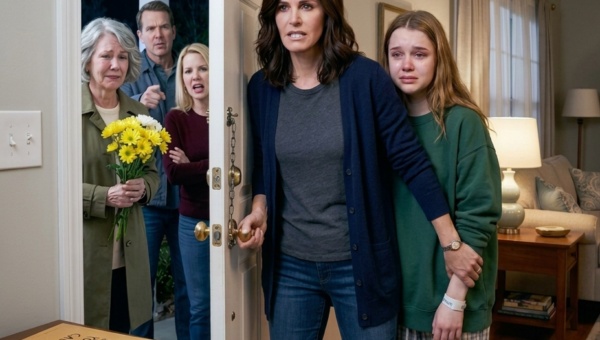
Before I could sit down to calm my trembling hands, the doorbell rang.
I peered through the living room blinds. Parked at the curb was Dad’s aging Buick LeSabre, and right behind it, a police cruiser. My stomach dropped to the floor.
I opened the door. There stood my father, eighty-three now, his frame shrunken but his eyes blazing with a fury I’d seen only a handful of times. Two uniformed officers flanked him—a woman with a kind, weary face (Officer Jennings, I’d learn) and a younger man clutching a notepad.
Dad thrust his finger. “That’s the one! She stole money from my account!”
Officer Jennings looked at me calmly. “Ma’am, we need to ask you a few questions. May we step inside?”
I nodded and led them to the living room. Jack appeared, screwdriver in hand, and stood silently beside me.
I held up my phone. “I’d like you to read this, officer. This is the only conversation I’ve had with my father in over a month.”
Jennings took the device. Her lips moved slightly as she read. Then she turned to my father. “Sir, this is a message from you asking her for money. Did she take funds from your account without your permission?”
Dad’s face purpled. “She sent me one dollar! One condemned dollar! It’s a mockery! She’s laughing at me!” His voice scraped like gravel.
The younger officer shifted. “But did she steal?”
“No! But it’s her duty—she’s my daughter!”
I stepped forward, my voice louder than I intended. “My wedding was three weeks ago. Not one person from my family showed up. No phone call, no card, no flowers. And then my father texts me demanding money as if I’m a bank machine. So I sent him one dollar. It’s not a crime, it’s a boundary.”
Officer Jennings handed back my phone. “Sir, this is a civil matter, not a criminal one. Filing a false report can have legal repercussions. I suggest you go home.”
Dad’s eyes darted between the officers and me. For a suspended moment, I saw the man who once taught me to ride a bike, who cried at my mother’s funeral, and then something hardened and he spat, “Your mother would weep to see what a cold woman you’ve become.”
It should have shattered me. Instead, it solidified something. “Mama would weep because you forgot how to love your own child, Daddy.”
The officers gently guided him out, his curses trailing like exhaust. The front door clicked shut, and I threw the deadbolt with a satisfying thunk.
I collapsed onto the sofa, and Jack held me while I shook, not with sorrow exactly, but with the aftershock of a long-overdue earthquake. Later, Mabel came over with tuna casserole and a bottle of Chardonnay. We three sat at the kitchen table, and I told the story start to finish. Mabel clasped my hand. “Honey, your mama always said you had a backbone of steel hidden in that soft heart. She’d be proud of you tonight.”
I drank my wine and thought of Mama’s last words, whispered in a hospital room decades ago: “You be strong, sweet pea. Don’t let them make you small.” I’d buried that wisdom under years of seeking approval, but tonight I dug it up and let it breathe.
That night I wrote in my journal: “Dear Mama, I finally did it. I hope you were watching.”
The next week, an envelope arrived from Michael’s address. Inside, a torn sheet of notebook paper: “You’ve ruined my wedding. Linda says you’re a narcissist. Don’t ever contact us again.” I held it over the sink and struck a match. The paper curled into black lace, then dissolved.
I called the local senior center the same day and signed up to volunteer. Within a month, I was reading aloud to a group of silver-haired listeners, their faces alight with interest, their hands reaching to pat my arm in thanks. I met a woman named Dorothy, ninety-one, sharp as a tack. She’d survived the Depression, two world wars, and the loss of a son. “Family ain’t blood, dearie,” she told me one day over checkers. “It’s the folks who sit at your table when you’re too sad to cook. Who’s at your table?” I thought of Jack, Mabel, Greta, Tom the retired mailman who’d helped us move—and I smiled. “Good people,” I said. She winked. “That’s all you need.”
Months folded into a year. Jack and I planted a garden out back—peonies, tomatoes, and Mama’s daylilies, transplanted from her grave with permission. I spent hours in the soil, feeling the cool earth under my nails, talking to the seedlings like old friends. I dreamed of my mother once: she stood in that garden, young and whole, and told me, “I’m so proud of you, Maggie. You look just like me when I decided to live.” I woke weeping, but it was a clean, holy cry.
Through a church friend, I learned that Michael’s marriage to Linda had imploded after eighteen months; she’d cited his gambling and lack of ambition. Dad had a stroke and was moved to a nursing home across town. I felt a pang—not of regret, but of distant sadness, the kind you feel for a character in a novel.
I never visited. I sent no cards. It wasn’t cruel; it was conservation of spirit. My garden bloomed that May with a riot of color, and I’d sit on the porch swing with Jack, watching the bees stumble from flower to flower, feeling a peace I’d never known.
One afternoon, while sorting through old books, I found a photograph I’d missed in my purge: me at six, riding piggyback on Dad’s shoulders at the county fair, both of us laughing at cotton candy. I studied it for a long time, then tucked it back into the book. The love in that image was real, once. But love, like a garden, needs constant tending. Some plants don’t survive the frost, and you can’t blame yourself for the weather.
Now, at sixty-three, I look at my wedding photos with fresh eyes. I still see the empty chairs, but they’re not gaping pain points anymore. They’re spaces—openings where new growth took root. The faces of my friends beam out, and I realize: those chairs were never empty. They were filled by everyone who actually showed up, in that moment and every day since.
So, if you’re reading this and you’ve ever felt invisible to your own family, know this: you cannot water a garden that refuses rain. You can only plant your own seeds somewhere else. And one day, you’ll look up and realize you’re surrounded by a field of flowers you never imagined. Blood may be thicker than water, but love is thicker than both. Choose the people who choose you back. That’s the only family worth having.