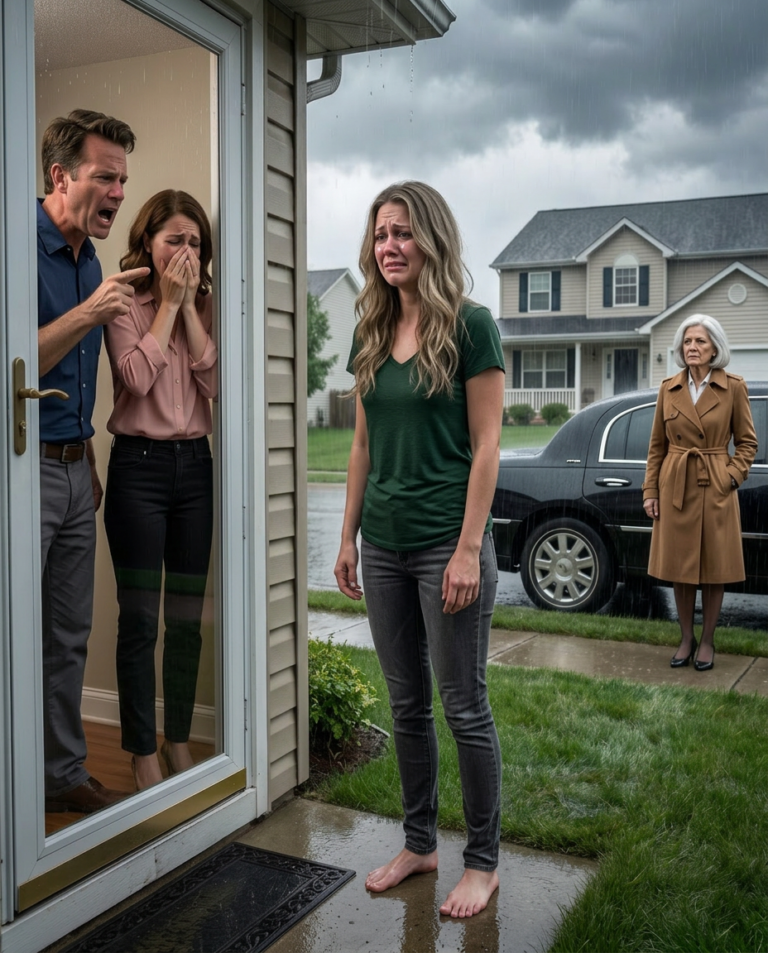

My Mom’s Friend Locked the Door Behind Me—Then Smiled, “Perfect Timing, as Always”

My Mom’s Friend Locked the Door Behind Me—Then Smiled, “Perfect Timing, as Always”
I remember the sound of the lock clicking behind me.
It was a small sound, sharp and clean, the kind of ordinary household noise most people would forget the moment it happened. But even now, years later, I can still hear it exactly as it was: deliberate, final, too precise to be accidental.

For a split second, I froze in the doorway with a plastic grocery bag hanging from each hand.
Mrs. Carter stood just inside the kitchen, her hand still resting on the door handle. She had already turned the deadbolt. Her posture was relaxed, almost casual, as if locking a 17-year-old boy inside her house was the most natural thing in the world. Then that familiar warm smile spread across her face, soft at the edges, the same smile I had seen at church functions and neighborhood potlucks for as long as I could remember.
“Perfect timing, as always,” she said softly.
I did not know what she meant.
Not then.
At 17, I lived in a state of constant motion. I was always late to somewhere, always impatient to leave one place and reach the next, always convinced that whatever I was doing at the moment was less important than whatever came after it. I had homework waiting at home, friends texting me, music in my earbuds, a half-formed plan for the evening, and the general arrogance of someone young enough to believe time was something that could be wasted without consequence.
My mother had asked me to drop off groceries for Mrs. Carter because her car was in the shop.
That was all.
Just a quick errand, she said.
On my way home, she said.
It’ll only take a minute, she said.
I had believed her. I had taken the bags from our kitchen counter with a sigh dramatic enough to make sure she knew I was doing her a favor. I had driven the few blocks through light rain, parked along the curb in front of Mrs. Carter’s little house, and carried the groceries to the side door like a dutiful son with better things to do.
I expected to hand them over, accept a thank-you, maybe endure 30 seconds of adult small talk, then leave.
But the lock changed everything.
That click made it clear I was not going anywhere quickly.
“Come sit,” Mrs. Carter said, gesturing toward the old wooden table near the kitchen window.
Her tone left no room for argument, but it was not harsh. It was gentle, even affectionate, which somehow made the whole thing stranger. If she had snapped at me, I might have pushed back. If she had seemed confused, I might have been alarmed. But she seemed completely in control, as if I had arrived precisely where she had expected me to arrive, at precisely the moment I was supposed to be there.
I looked at the locked door, then at her.
“Mrs. Carter, I really should—”
“Sit first,” she said.
There was something in her voice that made me obey.
I set the grocery bags on the counter. The kitchen smelled like cinnamon and rain, a scent so vivid it seemed to belong to memory even before I knew why. A kettle had already boiled. Two mugs sat on the table, steam rising from them in pale ribbons. Outside the window, rain tapped softly against the glass and gathered along the sill in trembling beads.
Mrs. Carter’s kitchen had always seemed old-fashioned to me. Not shabby, exactly, but preserved. The table was worn smooth at the edges. The chairs had little scratches near the legs. The curtains were white and thin, embroidered with faded yellow flowers. A ceramic jar stood near the stove, probably for sugar or flour. The whole room felt like a place that had been used by the same hands for a very long time.
She placed one mug in front of me, then sat across from me with the other.
For several seconds, she did not speak.
She only studied me.
I shifted in my chair, suddenly aware of the awkward length of my arms, the rainwater on my shoes, the impatient energy still buzzing beneath my skin. I wanted to check my phone. I wanted to ask again if I could leave. I wanted to escape whatever conversation she was building toward, because even then I sensed it would ask something of me I had not planned to give.
“You look just like your mother did at your age,” she finally said.
I smiled politely.
“Yeah, I guess that’s me.”
“Always rushing,” she said. “Always somewhere to be.”
I gave a small laugh because that seemed expected.
“I guess that’s me too.”
She nodded, but she did not laugh with me. She looked down at her hands, which were wrapped around her mug. They were trembling slightly. I had never noticed that before. Mrs. Carter was one of those older women who always seemed arranged: hair neatly pinned, blouse pressed, makeup just enough to look effortless. At church, she stood straight, smiled warmly, and remembered everyone’s name. She was the kind of person adults described as lovely.
But sitting across from her in that quiet kitchen, I saw something I had missed in every hurried passing.
She looked tired.
Not sleepy. Not sick in any obvious way. Tired somewhere deeper, behind the eyes, in the space between one breath and the next.
“You know,” she said, her voice lowering, “your mom and I used to sit here for hours. Talking about everything and nothing.”
That surprised me.
My mother had plenty of church friends, neighborhood friends, women she exchanged recipes with or called when someone needed help organizing a meal train or decorating the fellowship hall. Mrs. Carter was one of those people in my mind, part of the blur of adult relationships I did not bother to understand because they did not involve me.
I did not know they were close.
“She’d always bring those little lemon muffins,” Mrs. Carter continued, smiling faintly. “She knew I loved them. Didn’t matter what time of year it was. If your mother came through that door and I was having a hard day, there was a good chance she had lemon muffins in her hand.”
I looked toward the counter, where the grocery bags waited exactly where I had placed them.
“I didn’t know that,” I said.
“No,” she replied softly. “I don’t suppose you would.”
It was not an accusation. That made it worse.
The rain grew heavier outside, no longer tapping but brushing steadily against the window. The light in the kitchen dimmed. Mrs. Carter’s face seemed softer in the gray afternoon, and for the first time I noticed how quiet the house was. No television. No radio. No ticking clock. No sound from any other room.
Just rain.
Just steam rising from tea.
Just the two of us at a table where, apparently, my mother had once sat for hours.
“Your mom,” Mrs. Carter said, “was the first person to show up when my husband passed.”
I stopped shifting in my chair.
I knew Mr. Carter had died. Everyone knew that, in the distant way people know facts about the lives around them. It had been years earlier. I remembered women bringing casseroles, men standing in the yard in dark suits, my mother leaving the house with foil-covered dishes and returning late. But I had been younger then, old enough to sense sadness but too young to understand what it meant for someone’s house to become permanently quieter.
“Everyone else avoided me,” Mrs. Carter said. “Not because they were cruel. Grief just makes people uncomfortable. People don’t know what to say, so they say nothing. They don’t know how to help, so they stay away. They think silence is safer than saying the wrong thing.”
She glanced at the chair I was sitting in.
“But not your mother. She came in, sat right there, and said, ‘You don’t have to talk. I’ll just sit with you.’”
The words hung in the air.
I looked down at my tea. I had not touched it. The mug warmed my fingers when I finally wrapped my hands around it. Something in my chest tightened, though I could not yet name it. I had spent my life thinking of my mother as my mother: the woman who reminded me to take out the trash, asked too many questions, worried when I drove in the rain, and somehow always knew when I was lying about homework.
I had not often considered who she was to other people.
I had not imagined her sitting quietly in that chair, offering not advice, not solutions, not cheerful distraction, but presence.
The kind of presence that asks for nothing.
The kind that says, I can bear this room with you.
Mrs. Carter smiled again, but her eyes had begun to glisten.
“She sat here for hours that day. We hardly spoke. She made tea. She washed the dishes people had left in the sink. She found a place in the freezer for all the casseroles. Then she sat back down. Every time I thought I might fall apart, she was still here.”
I swallowed.
Outside, rainwater ran down the glass in crooked lines.
I suddenly felt embarrassed by my impatience, by the way I had carried the groceries to her door like a burden, by the fact that I had arrived already planning my exit.
“Why did you lock the door?” I asked.
I meant it as a joke, or at least tried to. My laugh came out thin and nervous.
Mrs. Carter smiled faintly.
“Because I didn’t want you to rush off before I said thank you.”
“Thank me for what?”
“For showing up,” she said simply.
I frowned.
“My mom asked me to bring groceries.”
“I know.”
“So I didn’t really—”
“You didn’t plan to,” she said. “That’s the thing about kindness. Sometimes it happens by accident, and that’s when it means the most.”
I did not know how to respond.
At 17, I understood duty in the simplest way. Someone asked. You did it or you did not. My mother had asked. I had done it. That did not make me kind. It made me available, maybe. Obedient enough. Mildly inconvenienced.
But Mrs. Carter was looking at me as if I had stepped into some larger pattern I could not yet see.
She reached into the pocket of her cardigan and pulled out a small folded photograph.
It was old and faded, the edges curled from years of handling. She unfolded it carefully, smoothing it against the table before sliding it toward me.
I looked down.
There were three people in the photo.
Mrs. Carter, younger then, her hair darker, smiling toward the camera.
My mother beside her, young too, bright-eyed, one arm extended as if she had just pulled someone close.
And between them, sitting on the very table where I now sat, was a toddler with cake crumbs all over his face.
Me.
I stared at it.
I had no memory of the moment. That was the strange part. There I was, unmistakably myself and yet entirely unknown to me, round-cheeked, messy, laughing or maybe about to laugh, held between two women who seemed delighted by my existence.
“I didn’t even know this existed,” I whispered.
“She gave it to me years ago,” Mrs. Carter said. “Told me to hold on to it until you stopped by just in time.”
I looked up.
“Just in time for what?”
Her smile turned wistful.
“She said you’d grow up to have her timing.”
“My timing?”
“She always knew when someone needed her most. Somehow, you’ve got that too.”
I almost argued. I wanted to tell her she was wrong. I had not known anything. I had not sensed her loneliness from across town. I had not chosen to come. I had been sent. I had complained. I had wanted to leave.
But the photograph held my voice in place.
There was my mother, younger than I had ever really imagined her. There was Mrs. Carter, before grief had settled into the corners of her face. There I was, small and loved, eating cake at a table where I had arrived years later carrying groceries and impatience.
Time seemed to fold over itself in that kitchen.
For the first time that afternoon, I stopped thinking about where I needed to be next.
Part 2
We sat there for nearly an hour.
I did not notice the time passing at first. That, more than anything, surprised me. I was the kind of teenager who measured every adult conversation in minutes lost, every errand by how quickly it could be completed. But in Mrs. Carter’s kitchen, time began to move differently. The rain thickened against the windows, the tea cooled slowly in our mugs, and the house that had felt too quiet at first began to feel like it was listening.
Mrs. Carter talked about my mother.
Not in the way adults usually talked to children about their parents, reducing them to lessons or warnings. She did not say, Your mother is a saint, or You should appreciate her more, or One day you’ll understand. She simply told stories, gently, as if placing small pieces of a life on the table between us.
She told me my mother used to come over without calling first because she said friendship should not always require an appointment. She told me they had sat in that kitchen when I was little, with me playing under the table or making a mess with cake, while they drank tea and talked about church, neighbors, recipes, bills, marriage, fear, and the thousand small things women carry without naming them.
“She never made me feel like a project,” Mrs. Carter said. “That was your mother’s gift. Some people help you and make sure you know they’re helping. Your mother helped like breathing. Quietly. Naturally. She just showed up and began.”
I listened in a way I had not expected to listen.
The photograph lay between us. Every so often, my eyes returned to it. The crumbs on my toddler face. My mother’s hand near my shoulder. Mrs. Carter laughing. I wondered how many ordinary afternoons had happened before I was old enough to remember them. How many people had held me, fed me, wiped my face, laughed at something I said, or watched me grow without ever becoming part of the stories I told about myself.
That is one of the strange cruelties of being young.
You think your life begins with your memory.
It does not.
You are carried into yourself by people whose names you barely know.
Mrs. Carter was one of those people. Until that afternoon, I had not thought of her as someone connected to me in any meaningful way. She was simply Mrs. Carter, a church friend of my mother’s, a woman with a quiet house and a car in the shop. But in that faded picture, she was part of the architecture of my earliest life.
She had known me when I could not speak in full sentences.
She had loved my mother through grief.
She had kept a photograph for years because my mother had given it to her with some mysterious instruction about timing.
I looked across the table at her trembling hands.
“How long has it been hard?” I asked.
The question surprised both of us.
Mrs. Carter looked down at her mug, then turned it slowly in her hands.
“A while,” she said.
She did not elaborate at first, and I did not press. Even then, I understood that some answers had to be invited but not dragged out. The rain seemed to fill the pause for her.
“After my husband died, the house felt too big,” she said eventually. “People came around at first. They always do when there are casseroles to bring and arrangements to make. But after a few weeks, life went back to normal for everyone else.”
She looked toward the window.
“That’s how it should be, I suppose. People have their own lives. Work. Families. Problems. But when everyone else goes back to normal, grief stays behind with you. It sits in the chair across from you. It waits in the hallway. It changes the sound of the front door. You learn to live with it, but you never really get the old house back.”
I thought about the quiet I had noticed when I arrived.
No television.
No clock.
No voices in other rooms.
I had thought the house felt empty.
Now I realized it was full of things I did not know how to see.
“My mom still visits, right?” I asked.
Mrs. Carter smiled, but there was sadness in it.
“When she can. She has her own life. And lately, I think I got very good at telling people I was fine.”
I recognized that phrase.
Fine.
Adults used it often, but it rarely meant anything simple. My mother said it when she was tired. My father had said it when bills were tight. Teachers said it when they were disappointed but did not want to start a longer conversation. I had said it myself when I wanted people to stop asking questions.
Fine was not always a lie.
Sometimes it was a door.
Mrs. Carter reached for the photograph and touched the edge gently.
“Your mother knows me well enough to hear what I don’t say. That is a rare thing. A frightening thing too, sometimes.”
“Did she send me here because she was worried?”
Mrs. Carter’s eyes lifted to mine, but she did not answer directly.
“She sent you here with groceries.”
“That’s not an answer.”
“No,” she said softly. “It isn’t.”
For the first time, I wondered what my mother had heard in Mrs. Carter’s voice that I had missed. What pause. What unfinished sentence. What note of loneliness hidden beneath ordinary conversation. I thought of Mom standing in our kitchen, packing the grocery bags and asking me to deliver them. Had she seemed casual? I tried to remember. At the time, I had heard only the inconvenience. I had not listened for concern.
Mrs. Carter did not accuse me of that.
She did not need to.
The afternoon itself had become an answer.
We talked about the old neighborhood after that. Not in a way that added great drama to the story, but in the way people talk when they are learning how to sit together. She mentioned families who had moved away, houses repainted, children grown and scattered, neighbors whose names I recognized only dimly. She told me my mother had once organized meals for half the block during a power outage, then insisted it was no trouble even though everyone knew she had done most of the work herself.
“She always said, ‘People remember who showed up,’” Mrs. Carter said.
I looked down at the photograph again.
“Did she say that often?”
“All the time.”
It sounded like my mother. Not the exact words, maybe, but the shape of them. My mother believed in presence more than speeches. She was not sentimental in obvious ways. She rarely gave long advice unless forced into it. But she noticed empty seats, quiet people, half-finished plates, unanswered calls, the way someone’s smile changed when they were pretending.
That had irritated me as a child because it meant she noticed everything I wanted hidden.
That afternoon, it began to look like a kind of love.
“What was she like when she was my age?” I asked.
Mrs. Carter laughed softly.
“Impatient.”
I grinned.
“So she was lying when she acts like she was perfect.”
“Oh, absolutely. She rushed everywhere. She wanted life to hurry up and become what she imagined. She had a temper too, though she learned to hide it better than most.”
“My mom?”
“Your mother.”
I tried to picture it: my mother young, restless, impatient, maybe slamming cabinet doors or rolling her eyes at errands. It felt impossible and obvious at the same time. Parents are people before they are parents, but children rarely believe that until someone else tells them.
“She was kind even then,” Mrs. Carter said. “But kindness changes as you grow. When you’re young, sometimes it comes in bursts. You feel something strongly and act. Later, if you’re lucky, kindness becomes discipline. You show up even when it’s inconvenient. You stay even when you don’t know what to say. You bring groceries. You sit.”
Bring groceries.
Sit.
Those were not grand gestures. They were almost nothing.
And yet, sitting across from Mrs. Carter, I understood that almost nothing can be enough when someone is lonely.
The rain began to soften. The steady wash against the windows became a lighter tapping. A car passed outside, tires hissing through wet pavement. Somewhere in another part of the house, wood settled with a faint creak.
I realized my phone had buzzed several times in my pocket.
I ignored it.
That choice felt small, but it was the first time all afternoon I had actively decided to stay.
Mrs. Carter noticed.
Her smile warmed.
“See?” she said.
“What?”
“Perfect timing.”
I shook my head.
“I still don’t think I did anything.”
“You came.”
“My mom sent me.”
“And you stayed.”
“You locked the door.”
She laughed then, really laughed, and for a moment I saw the younger woman from the photograph in her face.
“I suppose I helped a little.”
We both smiled.
The tension that had been in the room when I arrived had loosened. The locked door no longer felt like a trap. It felt, strangely, like protection. Not from danger outside, but from the part of me that would have run from the moment before I knew what it was.
Mrs. Carter’s hands were still trembling, but less now.
She folded the photograph carefully and slid it toward me.
“Take it.”
I hesitated.
“Are you sure? Mom gave it to you.”
“She gave it to me to keep until you stopped by just in time.”
I picked it up.
The paper was delicate under my fingers.
“You really believe that?”
“I believe your mother knows more than she says,” Mrs. Carter replied. “And I believe some moments find us before we understand why.”
I did not fully understand that sentence then.
I think I do now.
At 17, I thought timing meant arriving before the bell rang, catching the light before it turned red, getting to practice on time, making it home before my mother started calling. Mrs. Carter was talking about another kind of timing altogether. The kind that has less to do with clocks and more to do with need. The kind that places one person at another person’s door on a rainy afternoon with grocery bags in hand, even when he thinks he is only running an errand.
We finished our tea.
Or rather, Mrs. Carter finished hers. Mine had gone lukewarm, and I drank it anyway because leaving it untouched felt wrong after everything she had shared.
When I finally stood, I did not rush.
That seemed important.
Mrs. Carter stood too. She moved to the door, unlocked it, then paused.
“Wait here.”
She went to the counter and picked up a small paper bag, folding the top neatly before handing it to me.
“Your mom’s recipe,” she said with a wink. “Lemon muffins. I baked them this morning.”
I took the bag, and the scent rose immediately, bright and sweet beneath the lingering cinnamon and rain.
Something in me broke open just enough for a tear to slip down before I could stop it.
I wiped it quickly, embarrassed.
Mrs. Carter pretended not to notice.
“Perfect timing, huh?” I said.
She nodded.
“Just like your mother.”
Part 3
When I got home, my mother was sitting by the window with a cup of tea in her hand.
The rain had followed me back, softening the edges of the street and gathering in the gutters. The house was quiet, but not like Mrs. Carter’s house had been quiet. Ours had the lived-in silence of someone waiting without wanting to seem like they were waiting.
Mom looked up when I came in.
“You were gone a while,” she said.
I set the paper bag on the table.
“Mrs. Carter locked me in.”
My mother lifted her eyebrows, but there was a smile behind her eyes.
“Did she?”
“She said she didn’t want me rushing off.”
“That sounds like her.”
I studied my mother more carefully than I usually did. She sat with both hands around her mug, much as Mrs. Carter had, except her hands were steadier. There was something familiar in her face now that had not seemed important that morning. The same knowing smile Mrs. Carter had worn. The same quiet patience. The same way of letting silence do part of the talking.
I pulled the folded photograph from my pocket and placed it on the table.
Mom looked down at it.
For a moment, her expression changed completely.
She was not simply my mother then. She was the young woman in the picture, the friend in the kitchen, the person who had handed over a piece of memory and trusted it would find its way back when it was needed.
“I didn’t know this existed,” I said.
She touched the edge of the photograph.
“I wondered when she’d give that to you.”
“So you knew.”
Mom smiled into her tea.
“Mrs. Carter has been having a rough few months,” she said softly. “I was hoping you’d check on her one of these days.”
I stared at her.
“You planned this, didn’t you?”
She chuckled.
“Maybe I did.”
“Mom.”
“Maybe kindness just runs in the family.”
I wanted to argue. I wanted to say she could have simply told me Mrs. Carter was lonely, that she could have asked me to stay for tea, that she did not have to turn a grocery delivery into some strange inheritance of emotional responsibility. But the words never formed, because I knew exactly what would have happened if she had been direct.
I would have resisted.
I would have rolled my eyes, promised vaguely, and found excuses.
My mother knew that.
She also knew Mrs. Carter.
So she packed the groceries, sent me into the rain, and trusted an old friend to lock the door.
It was manipulation, maybe.
It was also love.
The two are not always as separate as we like to pretend, especially when mothers are involved.
I opened the paper bag and pulled out one of the lemon muffins. It was still faintly warm. The top was golden, the edges slightly crisp, and the smell carried me backward into a time I could not remember but somehow felt connected to. Mom broke one in half and handed part to me.
We ate in silence for a while.
Then I told her everything.
I told her about the lock clicking behind me and how I had panicked for half a second. I told her about the tea, the cinnamon smell, the quiet house, Mrs. Carter’s trembling hands. I told her what Mrs. Carter said about grief, about how people avoid it because they do not know what to do with it. I told her the story about the day Mom came after Mr. Carter died and sat in the chair near the window and said, You don’t have to talk. I’ll just sit with you.
Mom looked down when I repeated those words.
“That was a hard day,” she said.
“For her?”
“For both of us.”
I waited.
Mom ran her thumb along the rim of her mug.
“When someone you love is grieving, you want so badly to fix it,” she said. “But most grief can’t be fixed. It can only be accompanied. That’s harder than people think. Sitting with someone in pain without trying to tidy it up takes practice.”
“Did you know what to say?”
“No.”
“But you went anyway.”
“Of course.”
“Why?”
She looked at me then.
“Because she was my friend.”
The answer was so simple that it felt almost impossible.
Friendship, I realized, was not the warm vague thing I had imagined, not only laughter or shared stories or sitting together when everything was easy. Friendship was groceries. Tea. Showing up after funerals. Remembering lemon muffins. Hearing the word fine and knowing when it meant not fine at all.
It was a person who refused to leave you alone inside a room that had become too quiet.
Mom asked about the photograph, and I slid it toward her.
“What was happening here?”
She smiled.
“You had gotten into the cake before we were ready to serve it.”
“That sounds unlike me.”
“Oh, completely unlike you,” she said dryly.
Mrs. Carter had been upset about something that day, Mom told me. Nothing dramatic enough to become family legend. Just one of those hard afternoons people survive without marking the date. Mom had baked, brought me along, and somehow I had managed to smear cake across my face and make them both laugh.
“I remember thinking,” Mom said, “that it was the first time I’d heard her laugh in weeks.”
I looked at the toddler in the photograph.
I had no memory of offering anyone laughter.
But maybe that was part of the point.
Sometimes we give people something without knowing what we have given.
Sometimes our presence matters before we are old enough to understand presence.
That night, I took the photograph to my room and placed it on my desk.
I did not put it in a drawer. I did not tuck it into a book or leave it lying carelessly beneath school papers. I propped it against a lamp where I could see it from my bed: two women, one boy, one simple moment frozen in time.
The image looked ordinary.
That was what made it powerful.
Nothing in it announced itself as important. No one in the photo knew that years later, one woman would become lonely in that same kitchen, another would send her son with groceries, and the boy with cake on his face would sit at the old table learning that kindness could travel through time without asking permission.
The next few days, I found myself thinking about Mrs. Carter often.
Not constantly. I was still 17. I still had school, friends, impatience, and a world that insisted on being urgent. But something had shifted. When my mother asked me to run an errand, I listened differently. When someone said they were fine, I heard the door behind the word. When I passed Mrs. Carter’s street, I looked toward her house instead of looking past it.
The photograph became a quiet accusation and a quiet blessing.
It reminded me that I had been part of stories I did not remember, loved by people I had not thought to thank, shaped by kindnesses too small to appear on calendars and too large to disappear.
For a long time afterward, I kept returning to what Mrs. Carter said.
Sometimes kindness happens by accident, and that’s when it means the most.
At first, I was not sure I believed her. Accidental kindness seemed too easy, almost unfair. Surely kindness had to be chosen to count. Surely intention mattered. But the older I got, the more I understood what she meant.
Accidental kindness is not lesser.
It is simply unguarded.
It is the truth of who we are when we are not performing goodness for credit.
I had not meant to comfort Mrs. Carter that afternoon. I had not meant to honor my mother’s friendship or participate in a grief that had been changing shape for years. I had meant to drop off groceries and leave.
But I stayed.
Partly because Mrs. Carter locked the door.
Partly because my mother knew me well enough to send me anyway.
And partly because, once I saw the loneliness in that kitchen, I could not unsee it.
The smallest gestures can echo for decades.
A woman brings lemon muffins to a grieving friend. Years later, that friend bakes them for the woman’s son. A photograph is taken, folded, kept, and returned at exactly the right moment. A boy runs an errand, impatient and unaware, and leaves with a new understanding of his mother, of grief, of friendship, and of what it means to show up.
I used to think important moments arrived loudly.
I was wrong.
Sometimes they arrive with rain against a kitchen window.
Sometimes with tea in old mugs.
Sometimes with the click of a lock behind you.
And sometimes, if you are lucky, someone smiles and says, “Perfect timing, as always,” before you are wise enough to know she is telling you the truth.

Related posts