They Abandoned Me at 8—Then Came Back for Grandma’s $80M Will

My parents left me behind when I was 8, leaving me in Grandma Lizzie’s hands; 10 years later, they showed up at her funeral, demanding her $80 million estate, but when the lawyer read her will out loud, their faces turned pale!
The morning we buried Grandma Lizzy, rain tapped against the church windows like fingernails.
The lilies near her photograph were too sweet, too white, too alive for a room built around goodbye.
I stood beside the guest book with her lace handkerchief in my pocket, pressing my thumb against the folded edge because it was the last thing that still smelled faintly like her lavender soap.
People kept touching my elbow and saying I was strong.
I was not strong.
I was eighteen, newly alone, and trying not to fall apart in front of a framed picture of the woman who had been my whole family.
Grandma Lizzy had smiled in that photograph the way she smiled when she knew something other people did not.
Her eyes were soft, but they were never foolish.
That was the first lesson she ever taught me.
Kindness and weakness are not twins.
Some people confuse them because kindness gives them room to show who they are.
When I was 8, my parents showed her exactly who they were.
They drove me to her house on a bright afternoon with my pink backpack on my lap and a suitcase too large for me wedged beside my knees.
I remember my mother looking out the passenger window instead of looking at me.
I remember my father telling me not to make this harder than it needed to be.
At the time, I did not know what “this” meant.
I thought maybe Grandma was sick, or maybe my parents had a trip, or maybe if I behaved perfectly, they would come back by dinner.
The porch boards groaned under my shoes when I climbed out of the car.
Grandma opened the door before anyone knocked.
She was wearing an apron with flour on the front, and her hands were dusted white from rolling dough.
My mother said, “She’ll be better off here,” as if I were a bag being placed where it belonged.
My father set the suitcase down.
No hug.
No promise.
Then the car backed out of the driveway, turned toward the main road, and disappeared.
I stood there until the sound of the engine was gone.
That silence was the first thing my parents left me.
Grandma Lizzy did not say anything cruel about them that day.
She only came down the steps, wrapped both arms around me, and held me so tightly I could feel her ribs.
Inside, she made tomato soup and grilled cheese, even though I cried so hard I could not swallow.
That became the shape of our life.
She fed what my parents starved.
She sat through every school performance, every parent-teacher meeting, every winter concert where I searched the back row even though I already knew they would not be there.
She signed permission slips in blue ink.
She learned how to braid my hair from a library book because my mother had never taught me.
She bought birthday candles from the dollar store and acted like each one was made of gold.
When I woke with a fever, she slept in a chair beside my bed.
When girls at school whispered that my parents did not want me, Grandma packed an extra cookie in my lunch and wrote, You are wanted here.
For years, I thought that was all she had to give.
Love.
Soup.
Clean sheets.
A warm lap during storms.
She drove an old sedan with a cracked cup holder.
She clipped coupons and grew tomatoes.
She wore the same navy church coat for so long that the lining shone at the cuffs.
Nothing about Grandma Lizzy looked like eighty million dollars.
That was exactly how she wanted it.
The first time I understood there was another life behind the one I could see, I was twelve.
It was 9:43 p.m., and I had come downstairs for water.
The hall outside her study glowed under the door, and I heard her voice, calm and steady, speaking words that did not belong in our small house.
Trust instruments.
Asset schedules.
Beneficiary restrictions.
Probate exposure.
I froze with one hand around the glass.
When the call ended, I should have gone back upstairs.
Instead, I opened the door.
Grandma was sitting at her desk with her reading glasses low on her nose and three stacks of paper arranged so neatly they looked measured.
One folder was labeled guardianship.
One was labeled Whitmore Charitable Holdings.
One sealed cream envelope had my name on it.
She saw where I was looking.
For a moment, neither of us moved.
Then she closed the top folder and said, “Samantha, there are things children should not have to understand too early.”
I asked if we were in trouble.
She gave me the saddest smile I had ever seen.
“No, sweetheart,” she said. “But money makes people hungry.”
I did not know then that she was not talking about strangers.
She let the truth come slowly over the next few years, piece by piece, the way she loosened a knot in thread instead of yanking until it broke.
Her first husband, my grandfather, had helped build a logistics company long before I was born.
After he died, Grandma sold her stake, invested carefully, bought land quietly, funded scholarships through names no one connected to her, and learned to live like no one had anything to gain by loving her.
She had money.
A great deal of it.
She also had a daughter and a son-in-law who knew enough to be interested, but not enough to be patient.
My parents had not left me with her because they were poor.
They had not vanished because they were broken.
They had looked at a child and seen a burden, then looked at Grandma and seen a future estate.
That knowledge did not make the abandonment hurt less.
It made it cleaner.
Pain is sometimes easier to carry when it stops pretending to be confusion.
Grandma never asked me to hate them.
She never needed to.
She only told me to remember patterns.
A person who can abandon a child once will often return only when returning costs them nothing.
“The day they come back,” she told me when I was sixteen, while we sat at the kitchen table sorting old receipts, “do not mistake hunger for love.”
I laughed because I wanted the sentence to be less frightening than it was.
She did not laugh back.
“Promise me,” she said.
So I promised.
Two years later, I stood in a church hall after her burial, and my promise became a living thing in my chest.
My parents appeared at the edge of the crowd like grief had invited them.
My mother wore a black coat with pearl buttons and perfume so sharp it cut through the lilies.
My father wore leather gloves and the expression of a man entering a room where he expected deference.
They bowed their heads just enough.
Not enough to feel.
Enough to be watched.
I saw them before they saw me.
For one stupid second, something small and 8 years old inside me lifted its head.
Maybe they came because Grandma died.
Maybe death changed them.
Maybe grief had found a door pride could not lock.
Then my mother looked past my face to the photo table.
Her eyes moved over Grandma’s jewelry box, the framed letters from charities, the guest book, the condolence cards, the silver pen laid beside the register.
My father’s gaze moved slower.
He studied the room like inventory.
The little girl inside me went quiet again.
They reached me near the folding tables where church women had set out coffee, sandwiches, and slices of lemon cake.
My mother touched my cheek with cold fingers.
“Samantha,” she said, like she was trying on my name after leaving it in a drawer for ten years.
My father sighed.
“You’ve grown.”
There were a thousand things I could have said.
You missed it.
You made sure of it.
Grandma was there for every inch.
Instead, I said, “Why are you here?”
My mother’s smile faltered.
“Your grandmother was family.”
The word landed wrong.
Family had been Grandma sitting beside my bed with a thermometer.
Family had been her clapping alone in an auditorium.
Family had been her hands, cracked from soil, teaching me how to plant basil because roots mattered.
My father leaned closer.
His breath smelled like coffee and mint.
“Let’s not do this today,” he said. “There will be paperwork, and we should handle it like adults.”
“We?” I asked.
His hand landed on my shoulder.
I went still.
It was not comfort.
It was a claim.
“Don’t forget,” he murmured, “everything she had belongs to us now.”
For a second, the whole church hall seemed to tilt.
My fingers tightened around Grandma’s handkerchief until the lace cut into my palm.
I wanted to knock his hand away.
I wanted to ask him what part of ten years of silence he thought counted as inheritance.
I wanted to scream that he had no right to touch me like a daughter when he had not raised me like one.
But Grandma had taught me the value of locked jaws.
Some doors open only for people who can wait.
Around us, everyone heard enough.
Mrs. Alvarez from next door stopped stirring sugar into her coffee.
A cousin I barely knew stared at his paper plate.
The deacon froze with one hand on a chair.
No one stepped in.
No one said, She was the one who stayed.
No one said, You abandoned her.
People who had eaten Grandma’s pies, borrowed her tools, accepted her checks for church repairs, and watched her raise me suddenly found silence very respectable.
Nobody moved.
That silence hurt almost as much as my parents did.
My mother leaned closer and lowered her voice.
“Your father only means we need to be practical.”
Practical.
That was the kind of word people used when they wanted cruelty to wear shoes in the house.
Before I could answer, the church hall doors opened.
Rain-scented air rolled in.
Mr. Harris stepped inside carrying a thick leather briefcase, a blue probate folder, and a stack of sealed envelopes held together with a black band.
He was tall, gray-haired, and careful in the way old attorneys are careful when they know the room is full of people waiting to misunderstand them.
I had known him since I was twelve.
He sent Grandma holiday cards.
He had once taught me how to sign as a witness when Grandma updated a medical directive.
He also knew exactly why my parents had come.
Their posture changed the moment they saw the briefcase.
My father’s hand left my shoulder.
My mother smoothed her coat.
They moved toward the front row without being invited and sat like people waiting for a curtain to rise.
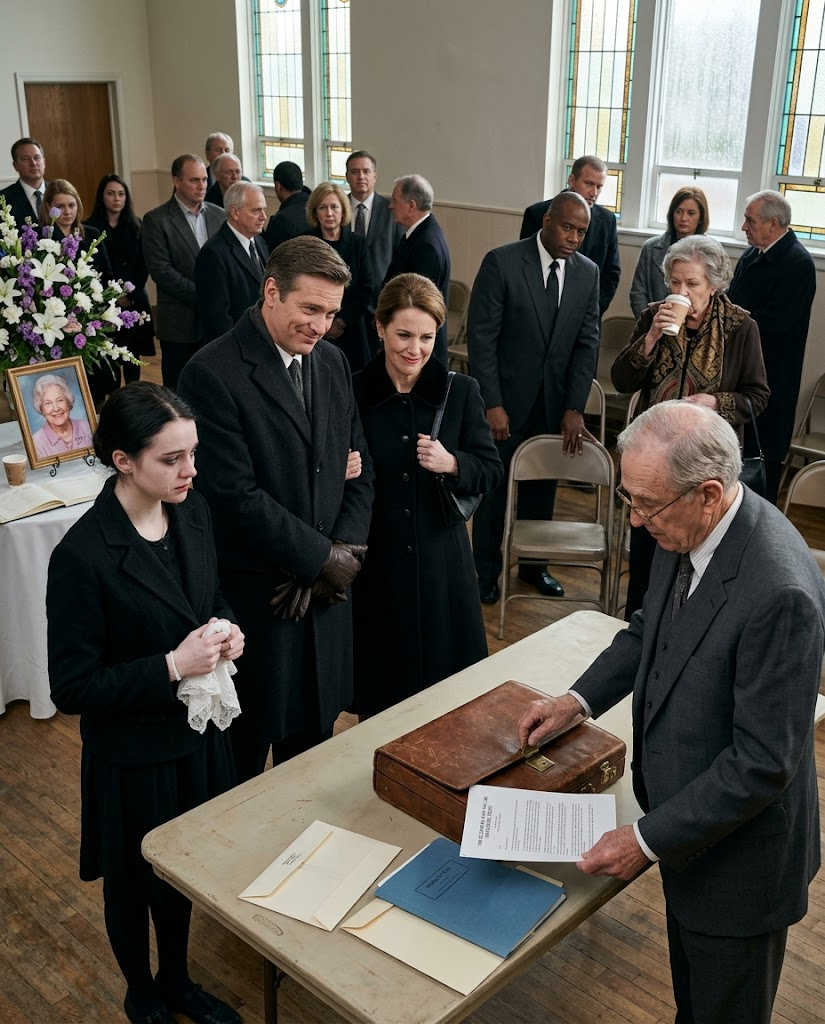
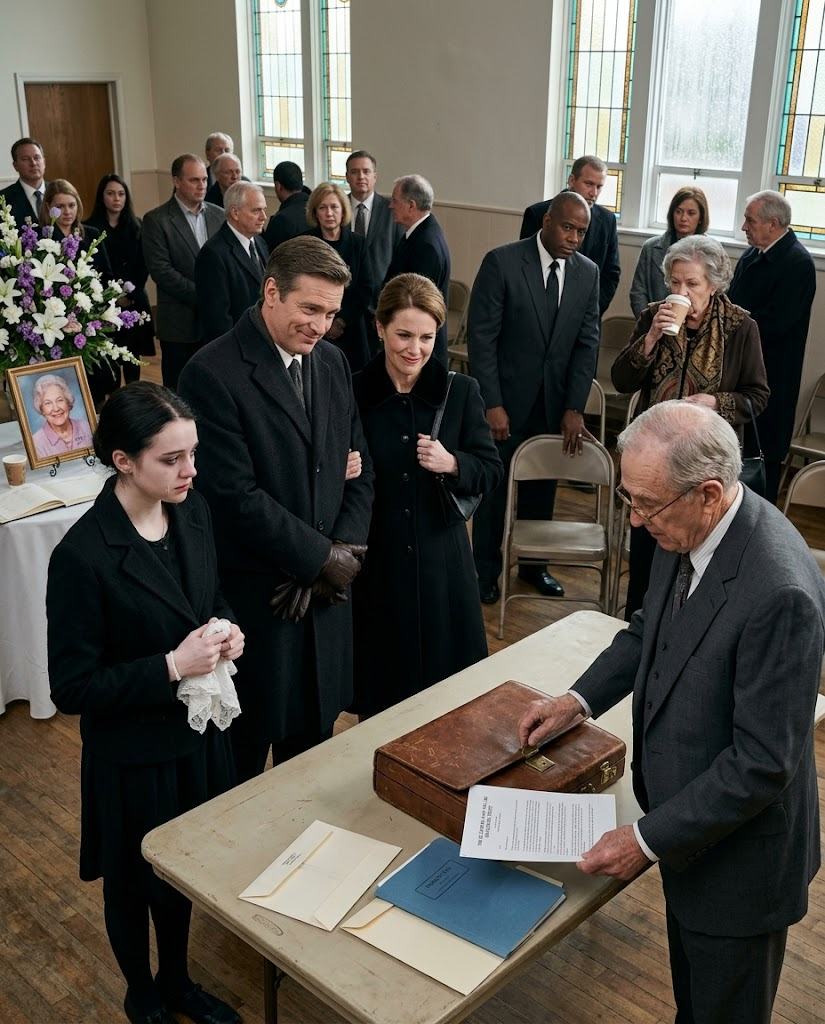
Mr. Harris placed the briefcase on the table beneath Grandma’s photograph.
The twin locks clicked open.
That sound moved through the room like a verdict warming up.
He removed several documents, aligned them with the edge of the table, and looked at me first.
Not at my parents.
At me.
“Samantha,” he said softly, “are you ready?”
I was not.
I nodded anyway.
My father cleared his throat.
“Can we proceed?”
Mr. Harris looked at him with a politeness so sharp it almost cut.
“We will proceed exactly as Mrs. Whitmore instructed.”
My mother’s lips pressed together.
Mr. Harris opened the blue folder.
“Before I read the final will and testament of Elizabeth Lizzy Whitmore, Mrs. Whitmore required that a preliminary statement be read into the record in the presence of any claimant who appeared at the memorial gathering.”
Claimant.
My father’s jaw moved.
My mother blinked too fast.
Mr. Harris unfolded the first page.
The paper shook only because the room was breathing around it.
“I, Elizabeth Anne Whitmore, being of sound mind and in full possession of my memory, make this statement freely,” he read. “If my daughter and son-in-law are present for the reading of any document concerning my estate, let it be known that their presence is not evidence of devotion.”
The room changed.
Not loudly.
Not visibly at first.
But I felt it.
Mrs. Alvarez lifted her head.
The deacon turned fully around.
My father gave a short laugh.
“That’s absurd.”
Mr. Harris did not look up.
“On August 14, when Samantha was eight years old, they brought her to my home with one suitcase and left her in my care. They provided no regular support, no medical authority beyond what I obtained through counsel, and no emotional presence.”
My mother’s face went white at the edges.
“She can’t say that,” she whispered.
“She did,” Mr. Harris said.
Then he continued.
“From that day forward, I acted as Samantha’s guardian in fact and, later, by formal guardianship order. Documentation is attached in Exhibit A, including school emergency contacts, medical authorization records, and correspondence returned unopened.”
Returned unopened.
I remembered the cards Grandma mailed.
I remembered choosing the stickers.
I remembered waiting for replies.
My throat closed.
Mr. Harris lifted another page.
“During the ten years of Samantha’s residence with me, her parents did not attend birthdays, school events, medical appointments, or holidays except where photographs could serve a purpose.”
My father’s hands curled over his knees.
My mother turned her head, but there was nowhere to hide in the front row.
“Mrs. Whitmore further states,” Mr. Harris read, “that any claim they make now shall be treated in light of the child they chose not to claim then.”
That was the first moment my father’s confidence cracked.
He looked at me as if I had written the words myself.
I had not.
Grandma had.
And somehow that made it more powerful.
Dead, she was still protecting me.
Mr. Harris set the statement down and opened the next document.
“The will.”
The room held still.
My mother straightened as if there was still some prize waiting under all that shame.
My father whispered, “Finally.”
Mr. Harris read the formal clauses first.
Names.
Dates.
Revocations.
The kind of language that makes grief feel notarized.
Then he reached the distribution.
“To my granddaughter, Samantha, whom I raised as my child and who treated me with love unconnected to expectation, I leave the Whitmore residence, all personal effects not otherwise designated, and the full beneficial interest of the Whitmore Family Trust, currently valued at approximately eighty million dollars.”
Someone gasped.
It might have been me.
My mother put one hand against her chest.
My father stood halfway.
“That can’t be right.”
Mr. Harris looked up.
“It is right.”
“I am her next of kin,” my mother said.
“You are her daughter,” Mr. Harris replied. “You are not her beneficiary.”
The words were clean.
Brutal in their neatness.
My father pointed at the documents.
“She was manipulated.”
At that, something in me finally moved.
“My grandmother raised me,” I said.
My voice sounded small at first, but it did not break.
“You left me with her.”
My mother turned on me.
“We did what was best.”
“No,” I said. “You did what was easiest.”
The room did not look away this time.
That was when Mr. Harris reached for the cream envelope.
The one with my name on it.
The one I had seen when I was twelve.
“There is more,” he said.
My father snapped, “Of course there is.”
Mr. Harris ignored him.
“Mrs. Whitmore anticipated an objection based on capacity, influence, or alleged estrangement. Therefore, she executed an additional condition.”
My mother’s eyes fixed on the envelope.
“What condition?”
Mr. Harris opened it with a small silver letter opener.
Inside were copies of letters, a guardianship transfer, and one handwritten page in Grandma’s looping script.
He read the condition aloud.
“Should my daughter or son-in-law contest this will, challenge Samantha’s inheritance, or attempt to remove her from the home I leave her, they shall receive nothing from my estate, direct or indirect, including any personal keepsake, family fund distribution, or discretionary payment.”
My father stopped breathing for a beat.
My mother whispered, “Nothing?”
Mr. Harris continued.
“If, however, they choose to apologize to Samantha in writing, acknowledge the abandonment, and make no claim against her or this estate, they shall each receive one dollar and a copy of the guardianship order, so they may remember the price of what they surrendered.”
One dollar.
A sound moved through the room.
It was not laughter.
It was recognition.
For ten years, my parents had imagined Grandma’s money as a door left unlocked.
Instead, she had built a mirror and made them stand in front of it.
My father turned red.
“This is vindictive.”
Mr. Harris closed the will.
“No. This is specific.”
That sentence stayed with me.
Because Grandma had been specific about everything.
The lunch notes.
The medicine doses.
The scholarship checks.
The emergency contact forms.
The unopened birthday cards.
The trust clauses.
Her love had never been vague, and neither was her final protection.
My mother looked at me then.
For the first time all day, she seemed to understand that I was not a child waiting by the window anymore.
Her voice changed.
“Samantha, sweetheart, we can talk about this.”
Sweetheart.
The word made my stomach twist.
She had not earned it.
I looked at her hands, manicured and empty.
I thought about Grandma’s hands, scarred by garden thorns and warm from soup bowls.
There are people who want forgiveness because they are sorry, and there are people who want forgiveness because consequences have arrived.
My mother wanted a receipt torn up.
My father wanted a lock picked.
Neither of them wanted me.
Not really.
Only access.
I pulled Grandma’s handkerchief from my pocket and unfolded it.
The lace edge was wrinkled from my grip.
Inside, stitched in faded blue thread, were my initials.
S.W.
She had made it for me the year I turned thirteen because I cried after a school dance when no one asked where my mother was.
She had sat beside me on the bed and said, “One day, you will stop measuring your worth by empty chairs.”
I had not believed her.
Standing there, I finally did.
Mr. Harris handed me the handwritten page.
The room watched, but his voice lowered.
“This part is yours to read when you’re alone, unless you want me to read it now.”
I looked at my parents.
My mother was trembling with fury disguised as injury.
My father was already calculating.
I knew that look.
Grandma had warned me about it.
“No,” I said. “Not for them.”
Mr. Harris nodded.
My father stepped toward me.
“Samantha, don’t be foolish.”
The deacon moved before I did.
So did Mrs. Alvarez.
So did two cousins who had been silent too long and seemed ashamed of it.
They did not touch him.
They simply stood.
That was enough.
For the first time, my father was the one facing a room that would not make space for him.
He looked around, saw no allies, and sat back down.
Mr. Harris gathered the papers.
“The estate process will proceed through counsel. Any communication to Samantha regarding assets, residence, or claims should come through my office.”
My mother laughed once, a brittle sound.
“You turned her against us.”
I answered before Mr. Harris could.
“No. You left me where love was. That was your mistake.”
The sentence surprised me.
Not because it was angry.
Because it was true.
My parents left before the reception ended.
They did not say goodbye.
They did not apologize.
They did not ask where Grandma was buried so they could visit the grave.
My father pushed through the doors first, and my mother followed, wiping at dry eyes for the benefit of anyone still watching.
Rain swallowed them in the parking lot.
This time, I did not chase the sound of the car.
I did not wait for it to turn around.
I stood beside Grandma’s photograph and let the room settle around me.
People approached slowly after that.
Some apologized for staying quiet.
Some hugged me.
Some were too embarrassed to meet my eyes.
Mrs. Alvarez took my hand and said, “Your grandmother knew.”
I nodded.
“She always did.”
After everyone left, Mr. Harris drove me back to Grandma’s house.
The house looked smaller in the rain.
The porch boards were the same ones that had groaned under my shoes ten years earlier.
For a moment, I was 8 again, standing beside a suitcase, waiting for someone to choose me.
Then I unlocked the front door with the key Grandma had given me and stepped inside as the person she had already chosen.
The air smelled like cedar, lavender soap, and the last batch of dried rosemary hanging over the sink.
On the kitchen table sat another envelope.
Samantha, it said.
My knees weakened when I saw it.
Mr. Harris stayed in the doorway.
“She asked me to leave that one here this morning before the service.”
I sat down in the chair where Grandma used to drink tea and opened it.
The letter was three pages.
I will not share every word because some love is not content for witnesses.
But the first line broke me open.
My dear girl, if you are reading this, then I am gone, and the hungry have come.
I cried then.
Not pretty tears.
Not quiet ones.
I cried like the 8-year-old on the porch, the twelve-year-old outside the study, the sixteen-year-old making a promise she did not understand, and the eighteen-year-old who had just watched the truth read aloud in a church hall.
Grandma wrote that money was not the gift.
The gift was the ability to live without begging people who abandoned me to finally see me.
She told me to finish school.
To keep the garden.
To give quietly when I could.
To let the house be a home, not a monument.
At the end, she wrote one sentence I have repeated to myself every day since.
You were never what they left behind, Samantha; you were what I was lucky enough to keep.
That was the real inheritance.
Not the $80 million.
Not the house.
Not the trust.
The real inheritance was the proof that someone had loved me deliberately, legally, daily, and without condition.
My parents thought they were coming to collect what Grandma owed them.
Instead, they heard what they owed me.
They owed me years.
They owed me birthdays.
They owed me the truth.
And because Grandma knew they would never pay those debts honestly, she made sure they could not collect interest on their cruelty.
I still live in her house.
The porch still creaks.
The garden still grows tomatoes.
Sometimes, when it rains, I stand by the window and remember the sound of my parents’ car leaving when I was 8.
It used to sound like abandonment.
Now it sounds like the beginning of being saved.

Related posts